Ruminations From the Western Slope

Ruminations From the Western Slope
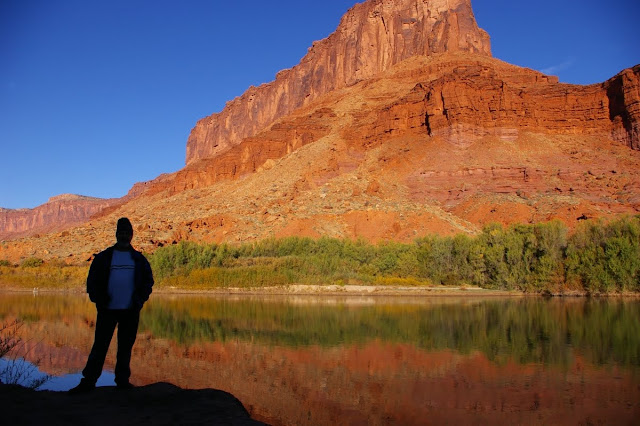
Colorado River near Moab, Utah

Saturday, February 4, 2023

FEBRUARY

It is the first of February and it is 15 degrees outside. January has gone once again and I have no regrets at its passing. But February can be a mean month, on the one hand tantalizing me with a day over 40 degrees, then slamming down the next day with snow and ice and temperatures in the teens. At the same time, the shadows shorten while the sun takes longer to make its arc over the red mesas. And I am sitting here waiting. Waiting for a glimpse of the first bulbs to appear along the garden wall. Waiting for the canyons to drip dry so that I can explore them once again.

I don’t like snow. I grew up without it south of San Francisco in what was once the Valley of Heart’s Delight but has now turned to Silicon. Back then an infrequent cold snap might cause a thin veneer of ice to form over the rain puddles. On our way to school, we would stomp on the slick surface and watch it heave and crack. But the snow stayed far away. We could see it occasionally on the top of Mount Hamilton or, once in a blue moon, up along the ridges of Skyline Boulevard under redwoods and madrone.

My folks never skied. Never did winter sports or vacations. I was blissfully unaware of frozen landscapes until one February when I participated in a church youth group ski trip. A bunch of us took a bus ride up to Dodge Ridge, stayed two nights in a nearby lodge, and the non-skiers like myself spent the days throwing snowballs and tobogganing down the steepest slopes we could find. I met my first real girl friend on that trip. And we sat together holding hands on the way home as the bus left the mountains behind and descended back into the lowlands.

Both of my parents’ birthdays and their wedding anniversary happened in February, so I was always scrambling that month to find proper cards and presents.

When I moved to Canyonlands as a park ranger in the 70s, I experienced my first real and regular snowfalls. It stuck like white frosting to the red rock cliffs and flocked the pinyon and juniper trees. I would have to scrape it off the government jeep in the mornings before going on patrol. It was both lovely and fearful as I labored to get up the Dugway on my way to Moab for supplies. But interspersed between February storms would be days of crystal clear skies and air sharp like peppermint, canyons limned in ice, hidden ancient ruins untouched by the weather. You could curl up in one of those alcoves and feel the warmth.

For me, February has its ups and downs, and memories both happy and sad. Now I take it one day at a time, knowing there will be disappointments, happy surprises and little detours along the way.


Monday, November 14, 2022

LOOKING BACK

My dad was much better at remembering the good times than my mother. To listen to my mother you would’ve thought that her life had been one long strand of misery and deprivation. But I don’t remember any of that. And the old photographs I am looking at today do not bear that out. I am leafing through snapshots taken in those days after the war in the years before and just after my mom and dad were married. I see the playful poses….my mother jumping on his shoulders, the two of them mugging for the camera. They are enjoying the outdoors….skiing, hanging out at the beach, riding on a boat. They are almost always with close friends, laughing at parties, drinks in hand. There are even happy times with me as a small child. I can tell from the photos that I was loved.


My dad almost always remembered the fun stuff. The childhood pranks. The oddball characters that he hung out with. He could always come up with a funny story or two about those early days on the streets of San Francisco. But my mother would dwell upon things she lost somewhere along the line. There was a bitterness and despair that was so deep I cannot fathom it, because as far as I can tell we grew up in a great environment. We were all healthy, happy kids. We were mercifully bereft of any great tragedies or terrifying events. We were well cared for and well thought of. We made it through high school and beyond. We married, had kids, developed senses of humor and independence, and became good citizens. Yet somehow life let my mother down in a big way.

There came a time when she could no longer stand my dad and only communicated with him through shouts and gripes. She let the television set turn her once quick mind into mush. She let the long life of a subservient housewife beat her down. But my father was not without fault in all of this. Long ago he shackled her independence, kept a tight rein on the purse strings, determined directions, and made too many important decisions on his own. Some time in the late 1960s, the two of them set off on different paths though still bound together by marriage. My dad chose to live in the moment and let the cards fall wherever they would fall. My mother elected to chain herself to a past that became more disagreeable the more she thought about it.

I am not sure what happened way back when. Perhaps nothing at all but the fabrications of a woman somehow disappointed by life. A woman who wanted something other than an obligatory postwar marriage, a house in the suburbs, and three odd and willful children. But the early photographic proof remains that there was once some happiness and joy that through time become cracked and stained with age. There are stories in these pieces at paper that I can never unlock.

Thursday, April 21, 2022

UNDER ORION'S BELT


As we drove into the Carrizo Plain from the south end, past the oil rigs and pump jacks in Maricopa, I could see that this was not going to be the verdant spring visit I had anticipated.  The land looked beat up and tired.  Soda Lake was dry.  The lumpy hills of the Temblor Range were devoid of vegetation.  And the washboarded road was playing havoc with our little camper/van.  Nevertheless we pushed on. And I became entranced once again with the sheer size and austere distances we were traversing.  And here and there I could see bursts of color.  A splash of goldfields in the chaparral.  A small bunch of roadside poppies.  A lupine or two.  These were the plants that were somehow hearty enough to reach full bloom.

 But our ultimate goal was to get a campsite in the KCL Campground, get settled in, and come up with a new strategy for exploring the Carrizo.  The campground in question has only about ten sites, and even fewer trees.  Questionable water (high in nitrates).  And a resident pair of Great Horned Owls who dwell in the large eucalyptus there.  As fate would have it, all the sites were taken.  Including a group site full of boy scouts from Santa Margarita. 

 In all the times I have camped here I have never seen a ranger of any type (it is managed by the Bureau of Land Management) nor are there any fees charged so, as unobtrusively as possible, we parked our van over to one corner of the camp and no one seemed to notice or to care.  In fact, the resident campers were downright friendly.  Across the way, Ren was traveling with her 16-year old cat, pretty much living out of her car.  She looked to be in her late 40s perhaps, in sloppy t-shirt and cargo pants.  Probably a real looker at one time but now missing four of her front teeth, and quick to tell us about her family’s ups and downs. 

 Next to us were two women who looked like researchers.  They had vials and killing jars and other various paraphernalia, and after talking to one of them, Sara, turned out they were, indeed, researchers trying to re-introduce important pollinators back into the valley.  Meanwhile, on the far side of the camp, live music was emanating from a campsite with two young men and two young women.  Fiddle, banjo, mandolin, guitar.  Bluegrass music and songs that laid down a quiet soundtrack to the afternoon.

 Ren was having trouble putting up her tent so one of the bluegrass boys came over to help.  Sara went to loan her a mallet.  Meanwhile, a pair of campers who came in late, asked us if they could set up behind our van and, of course, we said yes.  Later on I loaned them a table so they wouldn’t have to cook on the ground.  A Scout leader who had locked his keys in his car was appreciative when we gave him a wire coat hanger. Throughout the camp there seemed to be a real feeling of camaraderie and appreciation for where and who we were. 

 As the sun disappeared over the dark hills to the west, the hooting of the owls provided an impromptu chorus for the bluegrass players.  Campfires popped up all around us, and I had visions of the migrant camps in The Grapes of Wrath.  And when darkness took over, Orion rose into the center of the sky as if to watch over us and protect us all.  The Carrizo Plain no longer seemed austere and foreboding.  Our little campground was a beacon of goodwill and good feelings against the cold April night.  A small group of human beings huddled under a living canopy, pinpoints of light and life in a vast and seemingly endless landscape.  Under  Orion’s belt, we were caught up in the mystique and the magic of this raw and beautiful plain

Tuesday, March 1, 2022

Revisiting the Field


This morning I discovered where I was on Christmas Day of 1967.  I’ve been digitizing old slides, plowing through the memories, and there it was.  A picture of a bathtub in the Los Altos Hills dated 12/25/67.  The tub was on its side, having served dutifully as a cattle trough for many years, I am sure.  Beside it was an old wooden gate.  There were brown hillsides and a few oaks. And far in the background, I could see vestiges of the San Francisco Bay and the megalopolis surrounding it.  I have no other recollections of that afternoon but I bet I can reconstruct it pretty well.

That morning I would have spent with my family down in the flatlands of Mountain View, happily opening presents and sharing that all too rare feeling of togetherness.  My parents were no doubt worrying about the lengthening of my hair.  And my proclivity for wearing an old Army field jacket everywhere.  Little did they know that only a week before, I had dropped acid for the first time. Had spent the night in a crash pad in Santa Cruz with close friends, listening to Jefferson Airplane on headphones and being overwhelmed with color and sound. Feeling an overwhelming peace with the world, even as the spector of Vietnam lurked on the fringes.

But this was Christmas morning and I wasn’t high...yet.  And I cannot, for the life of me, remember any of the presents I may have gotten that morning.  But I’m sure we prolonged the process because it was that one time of the year that we were truly family.  We would have cleaned up all the wrapping paper, deciding which ribbons to keep.  Gone off and made inventory of our newly opened gifts.  And I might have stuck around until lunch time.  But at some point, one of my friends must have called me and said, “hey, we’re going up to the Field today.  Come join us!”

The Field was a large chunk of open space in the Los Altos Hills, a piece of land that had probably been a


sprawling ranch at one time but now seemed abandoned save for one big water tank at its crest.  The rest was quintessential California terrain.  Rolling land with dead gray grass, dotted with gnarled and twisted live oaks, bay laurel and chaparral.  We had “discovered” it about a year earlier while driving around the back roads getting stoned.  No one ever seemed to go there.  The land was open and inviting.  So we just called it “the Field” and began making regular pilgrimages there.  It was especially inviting in the spring when the grasses were a verdant green, and the mustard was blooming amid the apricot orchards.

More than likely on that Christmas afternoon, Phil and his sister Nina would have come by.  Or maybe my old buddy Stan.  Or any of about half a dozen co-conspirators who would whisk me away to our haven in the hills, smoking weed all the way as we climbed the winding roads beyond Foothill College and into the eucalyptus-tinged air of the coast range.  I am sure Nina would have been with me.  I was madly in love with her at the time.  She was my hippie ideal.  Skinny to a fault.  Long brown hair combed down straight.  Sharp features and deep, brown eyes.  Dark Italian skin to match my Greek-bred melanin. Short skirts.  All done up in paisley and beads.  Full of clever asides and laughter.

Our little group would have turned off the paved road onto a short, dirt drive ending at a locked aluminum gate and, to the right, a small opening in the neglected barbed wire fence.  From there it was a short walk uphill, toward the water tank, where we could all sit and smoke and look out over slate gray water of the bay, the winding sloughs, and the industrial onslaught that was usurping the shoreline.  We were likely bundled up against the December chill, but feeling the warmth of our companionship, the unspoken bonds, the outright laughter, and the blessing of many years spent together, nurtured by the same little community at the base of the hills.

Eventually the time would come to get up, lightheaded and silent, and walk back down the hillside toward the vehicle or vehicles that had brought us to this secret place.  And I think that was when I saw the old bath tub, lying on its side, rust stained and forgotten.  But a fitting memento to this place where the Ohlone once roamed, where the Spanish created a sprawling land grant that was eventually taken from them, and parceled out into farms and ranches overlooking the Valley of the Heart’s Delight below.  And now this precious little bit of acreage that was somehow spared the incursion of the wealthy.  The rambling ranchers and sprawling “starter castles” now hovering over what was soon to become the Silicon Valley.

But that Christmas Day was such a pivotal moment for all of us.  An exclamation point on the Summer of Love.  The lead-in to a year filled with intense highs and lows.  Assassinations. The fear of Selective Service.  Nixon as president. The joy of outdoor concerts, zoned-out camping trips, great bands at the Fillmore.  And toward the end, the dissolution of my romance.  The heart ache of once again being alone and having to navigate a world in confusion.  And a future that seemed both hopeless and hearkening.


*Afterthought:  “The Field” has long since been subdivided and filled with high-end homes, but a portion of it still remains as Byrne Park.


Thursday, July 1, 2021

The Manic Marriage


I had been a park ranger all of two weeks and I was already in love.  Not just with the gorgeously carved landscape of the Pinnacles that rose up all around me, but with a young lady who lived about 300 miles away.   I had met Karen the previous year when I was hitchhiking through Big Sur and needed a place to stay.  I wandered into her campsite and we ended up sharing a sleeping bag together under towering coastal redwoods….after which I made several hitch hiking forays down to the Orange County town of La Habra where she lived.  She was barely eighteen at the time, and I was a not-much-more worldly wise twenty-three, living on mescaline and unemployment checks in Santa Cruz, California.

 So here I was, now gainfully employed and with a spacious 12’ x 16’ one-room cabin, tucked amid the sycamore trees and chain ferns of Bear Gulch, in the shadow of the rugged High Peaks.  Within a month I had my own car, an old Plymouth Valiant, and the notion to drive down to La Habra forthwith to bringeth my fair damsel back with me to our little domicile in the chaparral.  And so it came to pass.  Karen took up residence with me in the cool days of late February as I learned my trade as an interpretive park ranger.

 There was only one catch.  We had to keep the fact that I was living in sin a secret from the strict Baptist park superintendent and the even stricter Mennonite head ranger.  So Karen stayed hidden indoors most of the time, or would venture out disguised as just another tourist schlepping around the park.  I’m not sure what made me think we could carry on this charade for very long because within weeks the head ranger’s two sneaky little sons figured it out and quickly reported our indiscretions to daddy.  Even more quickly, I was confronted by said father and told, in no uncertain terms, that I’d better get rid of the girl or get married.  As I was still in a trial period and in danger of losing my dream job, I had to make a hard and fast decision.

 “Well, I guess we’ll get married” was the obvious choice.  And the quickest way to accomplish our union was to head for Reno, Nevada where we could tie the knot within 24 hours.  But we did not want to do the deed alone.  We wanted some of our close friends to share in the festivities.  So we contacted Stan, Steve and Pam who readily agreed to participate in the celebration.  So the stage was set.  We gassed up the Valiant one mid-March afternoon and headed north for the two hour drive to Stan’s house.  We smoked at least one joint along the way.

 When we reached our destination, which was Stan’s parents’ house in Los Altos, we found him sitting halfway up an apricot tree, stoned out on acid.  Nevertheless, he eagerly jumped in the back of the Valiant and off we went for our second pickup….Steve and Pam in San Francisco.  They lived out in the avenues somewhere and were ready and willing when we finally found their apartment.  They joined Stan in the back seat as we made a beeline over the Bay Bridge, and east toward the Sierra Nevada.  Over the next few hours, much weed was circulated through the Valiant’s vinyl interior, and spirits were very high as we climbed ever upward.

 As darkness descended so did some unanticipated snow, and soon enough we were forced to find a set of chains somewhere so we could continue on our madcap marital adventure.  It was through sheer will that the five of us, in our spaced out condition, were able to install said chains and continue our journey to “the biggest little city in America”.  We pulled into Reno close to midnight, found a cheap motel, and rented a room for all five of us.  Karen and I took one bed, and Stan, Steve and Pam took the other.  But any semblance of sleep was to elude us as we congratulated ourselves on having made it over the mountains by taking mescaline.

 Came the dawn and we miraculously found the county courthouse where, after filling out the necessary paperwork, Karen and I were wed in a ceremony so brief I cannot remember any of it.  I do remember driving back up the Sierras, this time in bright sunshine.  We stopped somewhere near Donner Summit where we all got out and had a snowball fight.  Then back into the car for the drive down into San Francisco to drop off Steve and Pam, and then on down to the Peninsula to disgorge Stan not far from the tree we picked him up at.  But still before us was the two hour drive back down to the Pinnacles and our little cabin of dreams.  We arrived just as the late afternoon sun was throwing long shadows through the live oaks and gray pines.

 But here is the kicker.  After settling back down to domestic bliss, I was never asked to show a marriage license nor any other proof that we were legally wed.  We could have faked it, and we probably should have.  The marriage lasted just over two years, after which we amicably separated and I bought a copy of “How to Do Your Own Divorce in California”.  I learned how to do all the paper work myself.  Karen was a dutiful respondent. She and I split up our record collection, and she took the dog, and I returned to my life as a solitary ranger in a strange land.  In the end, the divorce cost me $18 in filing fees.

 And don’t think this valuable lesson was not taken to heart.  A couple of years later when I had fortuitously met another lady friend, and I was just about to move to southern Utah for a job at Canyonlands National Park, the two of us agreed to buy a couple of cheap rings, and masquerade as an old married couple.  Of course, the ruse worked.  And in the long run it was a lot less complicated and a lot less painful than making a midnight run to Reno.


Thursday, December 31, 2020

Christmas 2020


It’s 7 o’clock on Christmas morning.  The house is still asleep.  Outside a milky blue glow to the east silhouettes the trees and telephone poles.  No snow this year.  Just an icy stillness beyond the windows.  I am the first one up, as always, so I have already played Santa and stuffed the stockings that now hang distended from the mantle.  In a few hours all the packages underneath the tree will have been opened, their wrappings scattered about for the cat to play with.  But for now, there is a look of perfection, a kind of symmetry in all the squares, rectangles and oddly shaped bundles under the tree.

 The silence of winter,  The memories gathered over seventy Christmases.  Yuletides in the desert.  Yuletides by the sea.  And the almost ancient family ones in the heart of suburbia, when petty differences and misunderstandings were temporarily set aside for the laughter and comfort of home.  And mom was Mom.  And dad was Dad.  And the siblings were not a nuisance but necessary cogs in the familial wheel.

 The lites shine brightly this morning in spite of the decades.  Each ornament seems to have its own story so that the tree becomes an anthology of little vignettes and events, bound by the turning earth and all the people I love and have loved, and all the places I have been like this one, with a decorated tree in a corner of the room, on a cold morning in December and the beginning of another winter.

Friday, December 4, 2020

The Skylight

Several nights a month the full moon pokes its opal colored dome over the Grand Mesa, and slowly ascends into the Colorado night sky, losing both its warm hue and imposing size along the way.  As it rises ever higher, it gradually floats over Mantey Heights, sending milky shafts of light through the skylight in our bathroom.  Depending upon the time of year and the moon’s position in the sky, the light will slide down along the wall and into our bathtub or it may tickle our towel rack before reaching the floor. For a few hours, it becomes a celestial night light both calming and intriguing, and I look forward to its arrival every month.

 I have always wondered why more houses do not have skylights.  Why more people don’t eschew electricity for that natural light. When I was a small child in San Francisco, we had a skylight in our upstairs bathroom.  It was one of those kind that had chicken wire inside the glass that made a pattern of hexagons across the ceiling.  My grandmother’s old house in the City had one too.  Always emitting that clean, airy glow even through the numerous foggy days in the Richmond District.

 And when we moved into our new house just one year ago, I was immediately delighted to see that small rectangle of glass on the bathroom ceiling.  Since our bathtub was not fully functional, I put a dozen or so house plants in and around it, and it has become a nursery, the plants sending their tendrils upward toward the skylight and reveling in the humidity from the nearby shower.  And speaking of the shower, there is a real pleasure in soaping up under its steamy and streamy output, while looking up at a window of deep blue sky where I can gain some measure of what the day may be like outside. Sometimes I can watch the movement of whispy clouds overhead as I rinse the shampoo from my hair. Even on winter days when the snow lies heavy over the top of the skylight, the glow still filters through as if I am caught under some weird avalanche.

 But it is those moonlit nights that I love the best.  As I lie in my bed looking into the bathroom, the light slowly enters.  I’m never quite sure what part of the wall it will decide to invade, but it always makes a shaft that mirrors the skylight above it.  When I move in for a closer look, it seems as if the plants are swaying and reaching toward the ephemeral glow. There is a vibration of illumination. 

I know it is all reflected light from the sun and I can appreciate the science of it all. But mostly I can be grateful for that skylight where, for a few hours every month, I can capture pieces of that rather holy moonlight, and make it my own

Friday, November 13, 2020

Riding the Steel Bronco


Aside from a few commuter train rides from Los Altos to San Francisco, the first real train trip that I ever took was from Thompson, Utah to Oakland, California.  It was early January of 1975.  Three months earlier I had accepted a park ranger job in the Needles District of Canyonlands National Park and I was determined to take my live-in partner Susan with me.  This time we would pretend to be man and wife to avoid the quickie Reno marriage that I had endured as a very naïve seasonal ranger several years before.  In October, 1974, we left our home in the Salinas Valley with Susan driving her old VW bus, while I wrangled the small U-Haul truck with my Datsun pickup hooked to a tow bar in the rear.

We had determined to head to southern California first to retrieve some of Sue’s belongings before sequestering ourselves in the canyon country.  All went relatively well until we got to Santa Barbara.  I noticed that the U-Haul was driving erratically and when I pulled over to check it out, I was appalled to find out that somehow the Datsun had jack-knifed into the tow bar which had impaled itself to the Datsun’s front  bumper.  As fate would have it, we were rescued by a young mechanic in a nearby garage who separated said vehicles, but that left us with three vehicles to deal with and only two drivers. Realizing our dilemma, the mechanic told us we could leave the Datsun with him and pick it up at our convenience.  So, taking a huge leap of faith, we left my little pickup with a complete stranger in Santa Barbara, and continued on to Canyonlands.

By early January we had made arrangements to take the train back to California to retrieve my truck.  By that time, my friend Tom Ferrell had gone down to Santa Barbara on his own, rescued the Datsun, and had driven it back to Pinnacles where he was stationed.  These were the days before AMTRAK.  Our only option was to pick up the Steel Bronco, the northbound Denver & Rio Grande passenger train in Thompson, Utah, and make a couple of transfers to get us to our destination.  My district ranger Dave Minor dropped us off at the snowy platform in Thompson.  We were the only two people there when the train pulled in late in the afternoon.

It was the dead of winter and the cold night was only minutes away.  Sue and I were riding coach, of course, so we sat side by side sharing a blanket over our legs, watching as the hulking Bookcliffs turned into a long, jagged silhouette outside of Green River, then disappeared entirely. But we looked upon it all as just another romantic adventure.  We had only been living in Canyonlands for a few months, and already the sublime isolation and magic landscape had won us over.  We were feeling a little naughty as she gave me a hand job under the blanket as we rolled along.  We got to Ogden, Utah just before midnight and had to get off the train and board a bus to Salt Lake City where we picked up another west bound train around 1am.  I slept fitfully feeling cold drafts whenever anyone entered our car.  I remember waking up in Elko, Nevada and seeing snow falling.  But eventually we made it all the way to the bay area, got a ride down to Pinnacles, and retrieved my much-missed Datsun pickup, which was not too much the worse for wear.

After a day or two of visiting friends, we began the drive back to the Needles. I’m not sure where we slept that first night but I remember going through Cove Fort, Utah very late the following night with snow falling. Only a few pieces of Interstate 70 were complete so we were on and off of frontage roads most of the way, but happily reached our destination with two vehicles now at our disposal and a weird little adventure behind us. After all these years, I still love the sound and the feel of a train rumbling through the dark desert night as the steel rails rock me to sleep, and the mysterious darkness beckons.


Thursday, August 27, 2020

And Then There Was Elizabeth

 And then there was Elizabeth.  She was part of a San Francisco State poetry group that would meet at our little house on Geary Street back in 1969.  I was 22 and she was 30.  I was smitten almost immediately.  And somehow, we ended up together.  I had only lost my virginity about a month previous, and was feeling sexually inept but she was pretty and pretty patient with me and not at all aggressive.  She hung out with a fascinating group of people, all of them nearly a decade older than me, and some of them holdovers from the beat generation.  Most of them were into poetry and music.

 Barbara was kind of frumpy, short, wore glasses, and was married to Larry, an intense black man who played the flute.  Dorothy was the real beauty of the group with high cheek bones, perfect skin and a patrician air about her.  She was married to Donald, another black man who sported a huge Afro and was very outgoing.  There were several others as well whose names I no longer remember, although I do remember the couple that decided to name their child Amadeus, and remember thinking “Oh, he’s gonna love that when he gets older!”

 Most of them lived either in Berkeley or Oakland.  Elizabeth worked over there as a bank teller.  She liked my poetry, and apparently liked me as well because we spent quite a bit of time together, and I had no money and no vehicle.  She pretty much schlepped me all around in her old sedan.  Elizabeth was from southern California originally and had a thing for Bob’s Big Boy burgers, so one night we drove all the way down the peninsula to Mountain View so that I could have a Bob’s Big Boy Burger, which I had never had before.


 Another time I joined her and her friends for a day at the beach, somewhere down near Santa Cruz.  It was a pretty intimidating group, and I mostly just hung out with them and smoked dope, and listened to their conversation, much of it political.

 In November of that year, we all joined in a huge anti-war march through the streets of San Francisco.  There were an estimated half a million people who began the march downtown and ended up in Golden Gate Park.  There we were serenaded by the Youngbloods and other local bands.  I really felt like I was part of something so much bigger than me and that, despite my poverty and reliance upon others, I would get by.  In December she and I went to the ill-fated rock concert at Altamont, took mescaline, and sat way on the edge of the crowd.  The vibes were just too creepy and we left before the Stones took the stage. Back at the Geary Street house, things were turning ugly between myself and my room mates.  I was spending more time at Elizabeth’s place in Oakland, a two-story Victorian in a rundown section of town near the freeway.

 In spite of the rather bohemian group she hung out with, Elizabeth played it straight pretty well.  After all, she was a bank teller.  I liked going places with her but sometimes felt the age disparity between us.  As it happened, I abandoned the Geary Street house the following January and ended up moving down to Santa Cruz where I would spend the next year living on mescaline, unemployment, and the kindness of strangers.  Although we continued to see each other, the divide between us grew.  When I took up with a local girl that pretty much ended it.

 Eventually I got a job with the National Park Service.  And over the years, Elizabeth and I would see each other occasionally.  Some times we would sleep together, other times we’d just pass each other on the same road.  Ironically she ended up working for the Park Service as well.  We finally lost touch all together.  But I’ve been thinking about her lately, wondering if she is still around.  If she ever thinks back to those tumultuous times in the bay area when we shared in the energy, the uncertainty, the passion and the pain of a decade’s end. In light of what is happening now in 2020, it seems so distant and almost quaint by comparison.  But she got me through an equally difficult time way back when, and for that I will always be grateful.

Tuesday, August 4, 2020

Bud's Books

Bud Kalette owned one of the oldest book stores in Carson City, Nevada.  Books & Antiques was housed in the bottom floor of an old Victorian on Curry Street, which rumor had as a former brothel.  For many years, he was also my sister Elenie’s landlord for her vintage clothing shop, Revelations, which was located several blocks away in the same old neighborhood, dotted with Arts & Crafts bungalows and stately Victorian homes.  Bud’s store straddled the abrupt dividing line between the Sierra Nevada range just a few blocks away, and the Great Basin desert splaying out into an infinite eastern horizon. 

 Carson City had been the center of activity during the days of the Comstock Lode.  Mark Twain had lived and written here for a while.  The moneyed upper class, the successful miners and merchants built their fabulous homes as close to the mountains as they could.  And when the state of Nevada was established, Carson City became its capital.

 Drive a few blocks east from the vintage neighborhoods and the capitol building, and today’s Carson is an abysmal conglomeration of car dealerships, casinos, and strip malls lined along US Highway 395.  Several miles to the north is Reno, still trying to convince itself that it is the “biggest little city in the world”.

To the south, past Minden and Gardnerville, the road comes alive through places like Bridgeport where Robert Mitchum  starred in the noir classic Out of the Past, and Lee Vining, the gateway to Yosemite.  And just beyond that the tufa-studded shoreline of Mono Lake.

 In any case, my sister eventually abandoned the store idea, and a few years later old Bud passed away.  But Elenie knew Bud’s sister, who was liquidating the inventory, and who graciously allowed the two of us to have free reign in the store before all the books were sold off.  So one late summer afternoon, not long after the store had closed its doors forever to the public, the two of us were granted access to its dark and dusty shelves.  With only Bud’s sister hanging out at the counter, the two of us had as much time as we wanted to pick through boxes, open drawers, poke around the shelves, and just sit on the floor leafing through pages of history.


Bud had a fantastic collection of Western Americana, everything from books about Death Valley to the history of San Mateo County, California and the development of cable cars in the west.  He also had drawer upon drawer of antique postcards, the old hand tinted variety, carefully cataloged and arranged.

I ended up with a huge stack of hard-to-find titles, mostly regional tomes like a history of Inyo County and Memories of the Mendocino Coast.  I really could have looked for much longer but I wasn’t sure I could afford to do it.  As it turned out, when I went to cash out, Bud’s sister charged us a pittance to carry it all off.  


But the most priceless part of the experience was having the silence, the solitude and the time to just look to our hearts’ content, to graze through the piles of paper.  In the dim lower floor of an historic home. With no pressure to buy.  No crowded aisles.  But surrounded by the most wonderful array of written material one could imagine.  If I could have, I would have spent the night gladly on that hard wooden floor with all those books as my companions.  But eventually, like waking up from a blissful dream, we had to emerge into the harsh desert light and the white heat of reality.


Thursday, July 30, 2020

The First Time


From infancy until I was about sixteen, I spent portions of each summer with my grandparents at their farms in the San Joaquin Valley. When I was really young, it was at “the old farm”.  That was the one owned by my maternal grandparents, Gregory and Katie, just west of Highway 99 in Keyes, California.  It was 20-acres of Thompson seedless grapes and an old farmhouse that they’d acquired sometime in the 40s.  By the time I was going there, the old house had been replaced with a more modern, stucco edifice with a detached garage.  But there was still the old windmill tower and several huge locust trees that dominated the property.

I loved staying at that farm.  I had a real fondness for my namesake Popou Gregory, and I’d help him out in the fields with weeding and other chores, like picking hornworms off of the tomato plants.  And once a week we’d drive into Turlock where the grands would let me roam through the old 5 & 10 Woolworth store and buy a few comic books or toy dinosaurs that I could play with back at the ranch.  From the well-ordered vineyards and vegetable gardens, I’d fashioned in my mind an untamed wilderness to roam through.  It was a great experience for an eight year old with a big imagination.

My Popou Gregory died suddenly in 1957 when I was ten years old, and after that my summer visits happened at the “new farm”.  Which was a non-descript ranch-style home my paternal grandparents had built off of Barnhart Avenue, about three miles from the old farm but much closer to Highway 99, the main arterial through the central valley at that time.  I can remember running to the end of the street when the big freight trains rolled through, and waving at the “hobos” riding atop the box cars.  This was about the time that Southern Pacific was phasing out its old steam engines for the much uglier but more efficient diesels.

My Popou Gus and Nany Elenie had most of the farm planted in peaches with some vineyards as well on their 20-acred plot.  A large dairy farm abutted the property so the smells of manure and fresh alfalfa often wafted over the property.  I loved the freedom to roam around on my own but by this time I was feeling less inclined to spending two weeks of my summer in the hot central valley.  For my folks, I’m sure it was a great advantage to drop my sisters and I off at the Farm every summer, while they went off on their own vacations, usually down to Southern California to visit my Uncle John.  But that meant that we seldom took family vacations together.

In any case, by the time I was fifteen I was spending most of my farm time reading books under the grape arbor, or making comic books of my own.  Once in a while I’d roam out to the edges of the property where I could watch the cows over at the dairy farm.  But just across the street from the farmhouse was an unusual property, fronting on the main highway, that was part motel and part residence.  The large two-story house had blue-tinted windows on its upper story, and was occupied by an old widow named Mrs. Lazar.  Occasionally my grandparents would take us over there for a visit where she would serve us tea from a large samovar she claimed she had saved as she was fleeing from the Bolsheviks during the Russian Revolution.  Her broken English certainly gave her a cachet of credibility.

On that fifteenth summer, two interesting things happened at the Lazar place.  A large, above-ground Doughboy pool had been installed, and a granddaughter named Linda was visiting.  Linda had short blonde hair and was about my age, and clearly as bored as I was with being stranded in the hot, dusty valley.  One day my sisters and I were invited to come over and enjoy the pool with her,an invitation I was not about to turn down.  It had nothing to do with the comely Linda and everything to do with getting wet and cool under the unrelenting sun of the San Joaquin.  But I did notice, once we got to the house, that Linda was exceedingly friendly and looked pretty damn good in a blue flowered swimsuit.

As time went by, the four of us frolicked in the pool and Linda would often grab on to me and pull me under the water.  On one of those occasions, she grabbed me close and gave me a hard and heartfelt kiss.  We were underwater so my sisters had no idea of what was going on, and I was certainly surprised myself…especially when she did it yet again.  It was all I could do to hold my breath and to keep the bulge in my swim trunks from being too obvious.  As naïve as I was, I realized that something special was happening here and I needed to off-load my siblings.


After all these years, I’m not sure how we did it but eventually my sibs got out of the pool and went back to the grands’ farmhouse across the street, leaving Linda and I alone.  We eventually got out of the pool, stood against the old house, and kissed some more. I don’t recall talking very much and, if we did, I’m sure it was quite awkward.  But here I was finally able to practice a real movie-type kiss, and having it reciprocated.  But there was also a sense of guilt as well, and a feeling that this young woman was not only lonely but, given the circumstances, would probably go much farther than a mere kiss.which terrified me at the time.  She was clearly more worldly than I was.  A yell from my Nany Elenie across the street finally brought me back to earth, and the Farm.

For me, what had happened that day was monumental…and I gave a lot of thought to how I could get back over to the Lazar place and continue my amorous activities.  But the next day the Lazars were not home.  They had gone shopping in Modesto.  And the day after that, Linda was gone….back with her parents, no doubt.  And I was left alone to ponder the incident, and write letters to my friends to tell them what had happened.  Once my folks picked us up and took us back home to Mountain View, I tried in vain to get in touch with Linda again but never could connect.  And I wonder to this day what might have happened to her.  She seemed like the type who probably got pregnant early and maybe went through a couple of divorces and probably never found the companionship she was looking for.

As for me, it would be another year or so before I could practice my kissing skills again as I fumbled my way through high school relationships.  And it would be many more years before I lost my virginity.   But I always felt that it was Linda who pulled the little cord out from my back and wound me up for the world of mystery, romance and heartache ahead.

I did end up writing a little poem about it years later.


                in my fifteenth summer
I met the farmer’s daughter
who lived across the way
            by the walnut orchard

I was lanky adolescent
she was lonely young lady
            sent to draw me out of a turtles shell
            and setting my vision straight

her kiss was a fire in the magnet of August
             the slow beginning
            of my long road into the light

            an overture to bottled down dreams
            igniting one day of a summer

I never saw her thereafter
wondering still if she were real
or a prophecy of women to come

                       later she said
                       later
                       later.


Sunday, June 14, 2020

Petroglitch


When Amy and I got married in the fall of 1991, I asked my parents as a wedding gift to get us two round-trip airplane tickets to Albuquerque, New Mexico.  I’d been to New Mexico a few times but Amy had not.  My parents obliged and we were off.  We had planned about a two-week travel circuit that would take us all over the Four Corners area.  My friend Tom, who had driven all the way up from Arizona to attend our nuptials, graciously offered to take a bunch of our camping gear back with him and meet up with us along the way.  And so it went.

We flew to Albuquerque and spent several days in romantic B&Bs in Albuquerque, Santa Fe and Taos, taking in all the sights and falling in love with the Land of Enchantment.  We had perfect weather the entire time.  From Taos we drove up to Durango where we met Tom, and he gave us our camping gear so that we could continue on to Canyonlands where we spent several days getting lost in the slickrock, immersing ourselves in the Colorado Plateau autumn.  We eventually packed up the camping gear and sent it home, returned to Albuquerque via El Morro NM, and I returned to my job at Whiskeytown.  But we had been bitten by the bug, and thereafter I spent lots of time looking for National Park jobs in New Mexico that I could transfer ito.

As luck would have it, several years later in 1994, I saw a vacancy for Petroglyph National Monument, a relatively new national park area on the outskirts of Albuquerque.  I applied for the position and, son of a gun, if I didn’t get the job….as Chief of Interpretation and Cultural Resources.  By April of that year, we were back in New Mexico and absolutely thrilled to be there.  The job had its challenges as Petroglyph was an urban park right on the edge of rapid development along Albuquerque’s west side.  The City wanted to keep expanding and we were in the way.  But we had a dynamic young superintendent and a motivated staff, so for the first two years things went relatively well…until our superintendent got a better offer elsewhere and moved on.

His replacement was an Hispanic female with no prior supervisory experience.  But it didn’t matter to us at first because as a staff we knew we could keep the ball rolling and make her look good.  Suffice to say, that didn’t work out.  Early on she asserted herself to the staff, asking for strict schedules and subservience to her will.  And it became obvious, as well, that she had a real chip on her shoulder for Anglo males.  We began to feel her wrath daily.  She was particularly bothered by my air of independence.  She had me move my office from the visitor center where my staff was, to the administrative office where she could keep an eye on me.  Then she began to make up lies about me not attending meetings and not doing what she asked me to do.  She was becoming the Captain Queeg of the good ship Petroglyph just as  I was taking on the responsibilities of becoming a new father once again.

By the summer of 1998, the writing was on the wall.  She was out to get me. Several of the staff had already moved on.  I began compiling a file on her, and calling the regional office for help.  Everyone on the staff was miserable at this point.  We even got a visit from a Regional investigative team who spent several days interviewing all of us, but in the end they were powerless to do anything.  Meanwhile, I was applying for vacancies all over the place. I was a GS-12 at this point and looking for GS-9 positions anywhere that would get me out.  But every time my superintendent got a call about me, she denigrated my performance.  But then fate stepped in.

I had applied for a vacancy with the BLM at Red Rock Canyon near Las Vegas. It was a great job and I even got a chance for a face to face interview.  And it turned out that my evil boss was on vacation at the time and unavailable for comment.  So I got the job and proudly walked into her office upon her return to let her know that I was leaving.  Instead of congratulating me, she made the next several weeks miserable, not allowing me annual leave to help pack my things.  Not approving travel.  She was a bitch to the bitter end.  But I made it out.  And I sadly had to leave the NPS culture behind.

As it turned out, the BLM seemed to recognize my abilities and quickly promoted me to manager of Red Rock, giving me my grade back as well as my pride, and from there things only got better.  But Petroglyph will always be the stain on my career.  And that superintendent?  She was demoted a few years later for using her government credit card to pay off thousands of dollars in gambling debts. And I eventually got the dream assignment that brought me to Grand Junction, Colorado.

Monday, May 25, 2020

Last Time in Little Spring


It was over 45 years ago that I blew into this bizarre and beautiful place to begin one of the most extraordinary periods of my life.  I was young and fearless and full of energy when I started my tenure as a park ranger in the Needles District of Canyonlands National Park.  That was back in October of 1974.  And now I am back again, under a tangle of trees in campsite A7 in Squaw Flat.  Wooden Shoe Butte dominates the eastern landscape spreading its tentacles of sandstone in all directions, into the drainages of Squaw Canyon and Lost Canyon and the very edges of Salt Creek.  The almost holy silence here is broken occasionally by a squawking raven or a desperate visitor looking for a camp site.  I grabbed the very last one this morning at 930am.

And that was after a full bore drive down highway 211, passing cars at every opportunity in hopes of finding a site.  It helps to have driven this road three or four hundred times over the years, knowing every curve and canyon, recognizing individual cottonwood trees and petroglyph panels.  It begins at Church Rock junction with a long open stretch through overgrazed grass and sagebrush, the long climb to abandoned Ogden Center and through Photographers Gap, then down toward the drainage from Harts Draw and the flanks of the Abajo Mountains.   The section down the Dugway is steep and curvy and used to be treacherous in the winter months.  A few errant ponderosas have taken root in the Navajo sandstone.  Just beyond the switchbacks Indian Creek flows in from the south to give the canyon its name and character.

A thick canopy of trees heralds Newspaper Rock and forms an arboreal tunnel for several miles as the canyon walls stay close.  Here and there an etched big horn or shaman figure show themselves on a sandstone wall.  As the canyon widens, the trees stay with the creek while the road meanders along the base of high red cliffs.  The sky opens up, the sandstone pulls away, and the cattle appear around the grasslands near the Dugout Ranch.  The first signs of historic humanity for several miles.  I could finally put the pedal to the metal on the Subaru and make like lightning for the campground where I felt welcome and secure.

Little Spring Canyon welcomed me back again as well after a hiatus of many years.  My secret place, private getaway, and pleasuring ground is harder for a 69 year old man to get into than a 29 year old but I managed.  I kept thinking that this would probably be my last shot at it so I was determined to make it at least as far as the first set of springs under the cottonwood gallery downstream.  Having a walking stick really helped but I still stumbled and bumbled my way over the hard gray limestone and the crumbling weathered sandstone shelves.  I bouldered down a small pour off and squeezed through a rocky tunnel before reaching the edges of the canyon where I descended on an old deer trail to the sandy floor.

The memories came flooding back even before I had reached level ground.  I recognized an old juniper snag, little changed in four decades.  I remembered the first time Susan and I discovered this place, in the dead of winter no less. Frozen formations of ice along the banks portended bubbling pools in the spring.  And so it was.  By mid May there was lots of cold, fresh water seeping to the surface at the cottonwood gallery, then trickling on down the canyon in a series of pools, cascades and freshets.  Places to soak a naked body.  Places to make love in utter privacy and openness.

There was the time that Phil and I ingested some mescaline and spent a very long day hiking downstream as far as we could, to the imposing confluence of Big Spring Canyon and then to the even more imposing confluence  of Salt Creek.  We traversed ledges full of fossil crinoids and brachiopods.  We walked through dark polished halls of limestone.  We thought we could walk all the way to the Colorado River but we eventually got rimmed out.  And then we hiked all the way back to the front country.  All in one unbelievable day.

There was the time Cindy and I got caught in a savage rainstorm near the confluence of Big and Little Spring and hiked like hell to find shelter high above the creek.  I was expecting a flash flood that never came, but we spent a primal night in a large alcove above the springs, firelight flickering off of walls like a Pleistocene parlor.

One summer Mary Ann and I discovered a cache of ancient puebloan artifacts near the first spring.  There were several arrowheads, part of a woven yucca sandal, a ringlet of pressed desiccated flowers, an arrow shaft.  We stashed it all back where it came from.  I looked for it today but there are only a few flaked lithics left at the site.  For years we swore ourselves to secrecy that we would never mention the name of the place.  But people are still getting down there even though the canyon is not marked nor advertised. 

Yet today it did, indeed, seem to welcome me back.  The springs are not as vigorous as they used to be.  Clean, fresh water no longer bubbles out of the ground.  Instead there is a much smaller seep that feeds the creek with a shallow, algae lined run.  Maybe the water table has dropped.  Maybe too much water has been diverted over the years to keep the thirsty campers happy.  Maybe as with me, age has taken a certain toll. In any case, the big cottonwoods still hold sway.  They were all shades of gold and yellow today and huddled together thickly downstream, a riparian fortress I could not break through.


But none of that truly mattered.  I had made it back.  And I made it back out as well.  And I am grateful to be among a probable handful of people who have really experienced this place...and maybe it has become a secret place for them as well.  If there ever was an Eden it must have been very much like this hidden garden in the midst of a wilderness of stone.  I grow older and less able but the canyon remains and I know it is still there and still vital, and that's good enough for me.