Ruminations From the Western Slope

Ruminations From the Western Slope
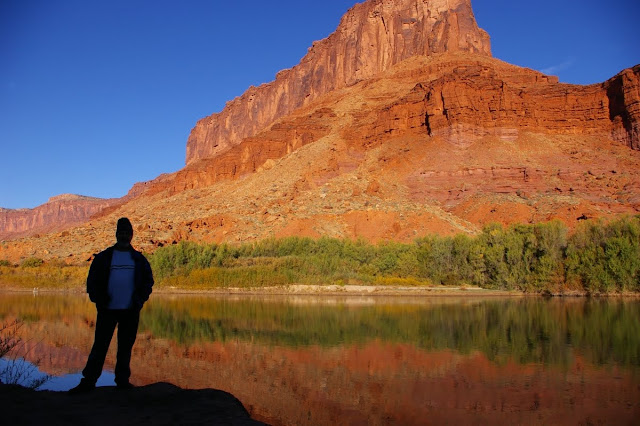
Colorado River near Moab, Utah

Sunday, March 24, 2013

It's All In the Journey


The older I get the harder it is for me to make my annual solo treks west.  Hard both physically and emotionally.  This last one found me driving 600-mles from Valley of Fire to Carson City through beat-up Beatty, Nevada over plains of desiccated sage; sleeping in the Subaru in an empty campground while a hard rain fell all night long; passing through a once-familiar but now unrecognizable neighborhood; getting lost in Sacramento; being stuck in a traffic jam on the interstate in Las Vegas; worrying about snow on the summits, and visiting a parent oxidized by age.

But it is the highlights along the way that make it all worthwhile.  The exhilarating drive over the San Rafael Swell; a walk with my daughter along the Truckee River in Reno; eating at a Greek cafĂ©; sharing a hot tub with sis while looking out over the Sacramento delta country; a lunch of fish ‘n chips on the coast north of Half Moon Bay; hiking into the morning misted Pinnacles surrounded by dew-flecked flora and volcanic monoliths; exploring a hillside in the Sierras where granite boulders fat with moss flanked gnarled oaks; watching The Big Lebowski again with my new son-in-law; good conversation with old friends; and that wonderful moment on the return leg when red rock cliffs rose up against winter-white mountains telling me that I was as good as home.

I can still do the journey.  I can still endure the long distances, though my hips and legs complain mightily.  While they ache in the background, my eyes take in the foreground – the vast expanses of west.  The wrinkled horizons of the Colorado Plateau or the razor straight horizons of the central valley and the delta. The tawdry towns.  The energizing interstates.  The rusty car, white trash heaps in the middle of Nevada.  The dilapidated house boats along the sloughs.  A pair of geese on the wing over the Sevier River. And in all these things the reflections of my life.  From a childhood where I watched the Valley of Hearts Delight morph into the Silicon Valley.  To a career as a park service nomad in seashore, mountains, and deserts high and low.

I will still do the journey for as long as I can. For as long as I am driven by that restlessness and sense of adventure.  As long as I can keep these old bones working and my mind fresh.  I always come home with something new, if only an intangible feeling of having once again survived the great open spaces of hope and anticipation.  

I can’t help it. I am an old man with young dreams.

Saturday, February 2, 2013

The Compost Heap of Hope


At the back of our lot in Grand Junction there is a home-made compost bin that rests against the garage and faces south into the sun. Made of old wood and chicken wire, it rises from the dead weeds and detritus in that forgotten part of the yard where pruned tree limbs, bent tomato cages, broken bricks, and pieces of pvc pipe meet their final resting place. It is as far from the front of the house as anything can be on our property, and its prosaic purpose in our lives is often forgotten….particularly in the winter months when one has to slog through the snow just to empty the household compost pail.  That would be the little clay urn that we keep by the sink that is mostly full of used coffee grounds and veggie trimmings.

Today was the first day in about six weeks of temperatures over 40 degrees, and it was time to empty the urn.  The last several times I did this chore required me to don snow boots, wool cap, and heavy parka just to get across the yard.  But today was decidedly different.  For one thing, I could actually see the lawn in places where patches of flat faded grass were straining for heat and light.  Other parts of the yard, suddenly freed from their icy blanket, were melting into mud bogs.  In one of our raised beds four crinkled chard plants re-emerged, battered but alive.

The compost bin was in full sun, still covered with November’s leafy mulch, and dotted here and there with onion skins, broccoli stalks, and an occasional tomato peel.  With a scattering motion, I emptied the urn’s soupy contents into the bin, taking satisfaction in the small bit of steam that rose from the surface.  Now it was time to take pitchfork in hand and churn the whole mess into a viable mixture.  As the tines broke through the crust they met resistance from stubborn pockets of ice.  I found myself turning over large chunks of material rather than the loose dirt that I had expected.  But as soon as the dark, dank underbelly was exposed, the ice crystals melted before my eyes.  The compost began to breathe again.

And I began to breathe again. Without the mucus in my nose freezing.  Without five layers of clothing on my body.  At that moment about a dozen geese flew overhead in V-formation, honking loudly and heading west.  And I swear I could almost see the grass unbending, the earth opening up in a broad brown smile, and the hibernating soul of myself finally thawing out on the backside of winter. 

Saturday, December 15, 2012

Stream of Unconsciousness


“You all must be crazy to put your faith in me.  That’s why I love mankind.  You really need me”.  – God’s Song, Randy Newman

Once again the all-too-familiar headlines.  Another mass shooting in another part of America.  More  appalling violence for no apparent reason by yet another deranged young man…followed by pundits asking why and wondering who to blame.  I am disgusted by my country’s love affair with guns, and I am disgusted with the religious hypocrites who tell us that God is punishing us or testing us somehow.   Have we not been tested enough over the past several thousand years, and is it not painfully obvious that we keep failing the tests?  Are you telling me that the same God who can impregnate a young virgin with his son and can also allow twenty innocent children to be murdered?  What kind of a god is this?
When I was a child my folks, out of some sense of religious obligation, sent me to the nearest church every Sunday which just happened to be Lutheran.  I sat through confirmation lessons wondering how the creation story fit in with my love of dinosaurs, wondering why according to the bible animals had no souls and babies were born with sin.  And what was this business of having to “fear and love God” all the time?  There was no joy in this teaching, only intimidation.
I went to church last night to hear my wife sing Christmas carols in the choir.  And along with the rest of the congregation, I willingly prayed for the victims, both living and dead, of this most recent tragedy.  I prayed not because I believe in God but because I believe in the power of the human spirit and the potential of positive human energy.  Isn’t this what prayer is really all about anyway?  God doesn’t answer our prayers.  We do.  And guns don’t kill people.  Humans do.           
We moronically submit to the gun lobbyists over second amendment rights when the fact of the matter is that our Founding Fathers could never have conceived of the kinds of weapons that now permeate our society.  If they had had any inkling about the deadly effects of assault rifles and similar tools of destruction, might the second amendment have been worded differently?  It is laughable to be applying 21st century logic to 18th century thought, as if the Bill of Rights creators could have been prescient enough to perceive the lethal efficiency of modern-day technology. 
I am tired of arguing with people whose entrenched point of view has blinded them to reality.  I am tired of the toxic atmosphere that seems to be spreading throughout our society.  Whether it is a shopping mall in Oregon, a movie theater in Colorado, or an elementary school in Connecticut, this is not God’s will.  It is the product of an amoral and indifferent society and we have to assume culpability.  We can’t blame God.  And we can’t blame the NRA.  We have to take some personal responsibility somehow.
It is hard not to be cynical in the wake of such senseless violence.  But on a good day, I can see examples all around me of the divinity that individuals are capable of whether it be raising money for a young child’s operation, feeding the homeless, rescuing abandoned pets, or gathering in a church just a week or so before Christmas to share in fellowship and song.
It is 5:30 in the morning and it’s raining outside and I don’t have any answers, just lots of questions.  And all I will want to do today is curl up on the couch with my daughter as the rain turns to snow.

Saturday, November 3, 2012

The Raking of the Leaves


It is autumn once again.  Once again I am swaying like the lingering leaves between bouts of euphoria over the stunning colors and sunshine, and moments of anxiety over the coming of the cold months.  Tonight we set the clocks back which for me is a mental set back as well as a physical one.  But in the meantime, I engage in the fall ritual of raking.  We have two large cottonwood trees on our property, two apple trees, an apricot, red buds, catalpa and various other deciduous plants.  Throughout the neighborhood I hear the drone of leaf blowers as the piles of organic detritus grow all along the curb.

       Sometimes I use our leaf blower but mostly I prefer the old fashioned flat-tined rake.  I can work it into crevices and between shrubs in the garden.  I can get into the rhythm of the sonorous sounds of the rake against concrete.  But mostly I can be outside in the long-shadowed sunshine, thinking mostly good thoughts.   Today I am remembering two old friends, now gone, and how different my life might be if they were still around.

      I was lucky to have grown up with the same four or five close male friends through junior high and high school and into college.  I knew Jim from the sixth grade.  He had a truly extraordinary intellect, a rapier wit, and an anarchic spirit.  He and I spent countless hours in animated conversations, first on the school yard, later in smoky rooms or remote beaches or on long drives.  Lots of talk about politics.  About the future.  It was during the Vietnam War era and Jim did not want to be drafted.  Concerned about drawing a low lottery number, he instead joined the Navy.  But several years later he died under mysterious circumstances while stationed in southern Spain.  Ironically, when his lottery number came up it was high enough to have kept him from the draft.  He was only 24 years old.

      Ron was a charge-ahead lover of life, inveterate prankster, gifted photographer, and wild man.  He was physically large but limber like a cartoon character.  When he and I would perform our comedy shtick (usually under the influence but sometimes not), he could pick me up and toss me like a rag doll and I could pop up again laughing and unhurt.  We’d go off on photo junkets to the redwoods or the coast or Golden Gate Park full of ideas and mirth.  After he got married, he and his wife moved to Seattle and he became a dad.  He was only 34 when he died of a rare form of cancer.  His son was less than two.

      Five close male friends, two of them gone in their youth.  Quite an attrition rate, and one that has left me wondering.   If Ron and Jim were still around, what kind of relationship would we still have…or would we have any?  Would we still be on the same page politically?  Would we dig each other’s families?  Would our lives be similar enough that we could share in the subtle pleasures of a quiet autumn day and a well-raked lawn?  

      The older I get the more I miss those two guys…the opportunities to reminisce about the old days and celebrate the new ones.  They are gone but I have sixty-five autumns under my belt and, hopefully, lots more leaves to rake.

Sunday, October 14, 2012

Life in the Needles, Part 2


My first day on the job in Canyonlands, I was confronted by Harry Yount, first-ever park ranger and mountain man of Yellowstone, whose leathery countenance stared out at me from a faded photograph in the dilapidated trailer we called an office in the Needles District – the very same trailer, I was told, in which Ed Abbey wrote Desert Solitaire when he was a seasonal ranger at the Arches.  Over the next few weeks, I’d hear this particular rumor applied to several other weathered metal hulks scattered throughout the canyon country,
My first assignment in the Needles: Learn how to drive a jeep, and head up to Davis Canyon to repair a vandalized cliff dwelling.  I was introduced to Ken, a fellow ranger and native of Moab, Utah.  Within minutes of our meeting, we were in a lime-green government rig, moving quickly under a cool gray sky.
About five miles from headquarters we took the turnoff to Davis Canyon, leaving the paved road and the broad valley of Indian Creek for the avenue of cliffs beyond.  I absorbed as much of the scenery as possible while Ken drove the first part of the canyon, offering tips on vehicle control and pointing out ruins.  I settled into the bouncing rhythm of the jeep and began training my eyes to see the subtle signs of prehistoric habitation – little square windows against a cliff, methodical layers of sandstone masonry.
Shortly past noon we reached our destination, a narrow drainage filled with Indian ruins on both sides.  The one we were looking for was perched on a ledge under a pothole arch and we’d have to climb down to it from above
The air grew chill and dark, biting against our faces as we climbed the rounded cliffs of sandstone.  We were soon on top, moving carefully across ledges, carrying rope and climbing gear over our shoulders, stopping finally at a large horizontal hole in the cliff twenty feet across and shaped like an immense toilet seat. 
We walked around the far side of the hole until we could see below us a narrow ledge about fifteen feet away.  Perched upon it was a small square structure of earth and stone.  A nearby juniper provided a belay point for our ropes as we tied them off and rappelled down to the ledge.  The ruin was about five feet thigh, its ceiling built squarely against a curving wall of the arch.  A wooden floor divided it in half, and there was a small opening in each level.  I marveled at the workmanship, at the ancient fingerprints still visible in the dry mortar.  It was a two-story granary of some kind.
A small dried up corn cob lay nearby, its shape barely altered by time.  While it looked like it might have been discarded only recently, we knew we were looking at an agricultural product from 700 years before, preserved intact by the dry climate. We began looking for signs of vandalism.  The granary was in excellent shape, probably visited by only a handful of people a year.  But around its backside, nearly hidden in the shadow of a nearby wall, someone had carved their message in the ancient clay, in letters almost an inch high:
HA-HA. WE WERE HERE BEFORE YOU.
As the sky darkened through the oval opening above us, I could almost feel the presence of Anasazi spirits condemning the modern intruders. I turned to Ken and suggested we wet some of the fine red dirt, make a paste out of it, and plaster it over the letters.  We mixed our saliva with the dust, making clay in our palms and applying it to the graffiti.  The letters disappeared as the clay blended in, and the wall’s original appearance was restored.  As we paused to admire our work, we hear the sound of rain up above.
“Jeez, we’d better get out of here fast before the rock gets too slick!  Do you know how to use jumars?” Ken asked.
“It’s been a while, but I think so.” Actually, I sucked at using jumars but I didn’t want to admit it.
We quickly attached the jumar handles to the dangling rope, their looped ends going around my boots.  I began my ascent, slowly lifting each handle and each leg in unison as the rain increased in intensity.  It was slow going as the rope became damp and slippery.  I was nearly halfway to the top when I saw a small trickle of water spilling over the same notch where the rope hung.  Soon it was splashing my face and running over my hands.  Despite mounting anxiety, I managed to reach the top.  I immediately dropped the jumars down to Ken.  By this time, a small stream was flowing over the lip of the arch, pouring right onto Ken who was struggling with the equipment, trying to slide each jumar up the saturated rope.
When he neared the top, I grabbed the rope and pulled with all my strength until Ken made it over the lip and onto relatively level ground.  We swiftly gathered our gear and headed over the rocks toward the jeep, the rain now a relentless torrent, unleashing waterfalls and sudden streamlets from every direction, as if someone had turned on hundreds of faucets all at once.  Slipping several times as we ran, ropes dangling, packs bouncing, we soon saw the jeep just a few hundred yards away.  By this time my near-panic had turned from our slippery climb to the flash flood that might come sweeping down the canyon at any minute if the rain continued.
But almost as soon as we reached the jeep the torrent ceased, the roar of the water rapidly diminishing until only a few small waterfalls could be heard.  The air regained its dry demeanor and the aroma of damp sage filled the canyon.  A few squawking ravens flew by, their cries echoing off of moist sandstone.  I took my place behind the wheel and began driving the sandy road out of Davis Canyon, commenting to Ken as we rumbled homeward, “If every day here is as exciting as this one, I may not survive this job!”
I was half-joking, soaked and exhilarated, and breathless in a new realm.