Ruminations From the Western Slope

Ruminations From the Western Slope
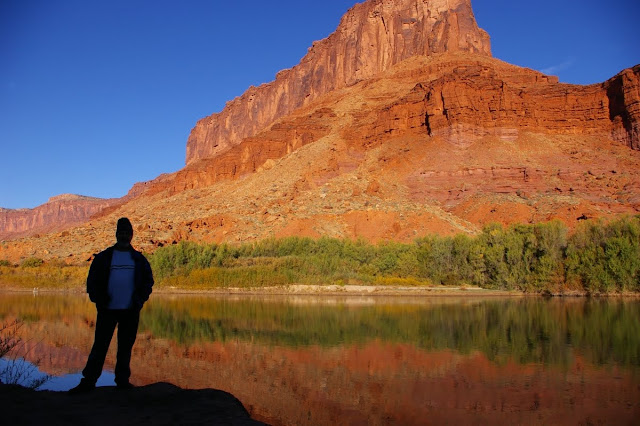
Colorado River near Moab, Utah

Monday, September 24, 2012

Life in the Needles, Part One


In 1974, the Needles District of Canyonlands National Park was still a fairly isolated outpost, located some 40 miles from a state highway and nearly 80 miles from Moab, Utah, population 4,000 and falling.  The uranium boom was winding down and jobs were scarce.  People were moving out of southeastern Utah as I was moving in.  It was an ideal time to be a young park ranger in the heart of the canyon country.  As naive and untrained as I was, the situation seemed to suit my needs at the time.

I’d been in the National Park Service less than four years, stationed less than 80 miles from the San Francisco Bay Area.  Somewhat isolated but close enough to civilization to periodically take in the hum and bustle of the Peninsula.   Nothing really prepared me for the long distances, deep silences, and the staggering scenery stretching into infinity in all directions.  But after only a few weeks, I embraced the change.  After all, I had a comfortably large mobile home, a willing and loving female companion, a regular, if small, paycheck, and a job that demanded my immersion in cowboy lore, ancient Indian ruins, white-knuckle jeep trails, and red rock.

Red rock everywhere.  It formed the monolithic Squaw Butte in which the housing area was nestled.  It defined many of the jeep routes and foot trails.  It rose up all around us in towering pinnacles, mesas, hoodoos, alcoves, arches and high plateaus.  It spread fingers of sandstone into curving canyons of infinite variety.  And at the far edges of the horizon, it was overlorded by dark, lacolithic mountain ranges like the La Sals, the Abajos, and the Henrys.

For me, there were two nearby pockets of civilization….our office and housing area at Squaw Butte, and the nearby campground at Squaw Flat.  Daily life centered around the patrol, either by vehicle or on foot.  The two-wheel drive patrol covered the few paved roads in the park and the campground area.  Where the pavement ended, the 4-wheel driving began…over places like Elephant Hill, the Silver Stairs, and SOB Hill, or up the winding stream beds of Salt Creek or Lavender Canyon.  But best of all were the foot patrols.  Making a living by hiking all day, replacing rock cairns, checking out rock art sites, and communicating with the occasional hiker.

At the end of the day, there was my trailer home with its faux wood paneled walls and orange shag carpeting, government-issue furniture, book shelves made of bricks and boards, the record collection, books, two cats, a comfortable bed, hot and cold running water, and companionship.  One could not ask for more.  But there would be a lot more in the months and years to come.


Friday, July 13, 2012

Growing Up In "Empty View"


Two events occurred in 1954 that vastly improved the quality of my life.  In the spring of that year, I had my tonsils removed, drastically reducing my propensity for getting colds.  And in the fall of that year my parents moved us all from the foggy climes of San Francisco to the sunnier suburb of Mountain View, about 35 miles south on the Peninsula. Now this is where my sister Katie would chime in that her birth that October might have also improved the quality of my life, but I wouldn’t see that as a benefit for several more years.  After all, I was only seven years old at the time and had more important priorities than acquiring another sibling.

What caused my folks to move to this specific location is unclear, but for me it was absolutely liberating.  Mountain View’s broad suburban streets and tree-lined avenues seemed like well-manicured farm country, even though there were few farms left even then.  But the valley’s agricultural legacy was kept alive by the single fruit tree that came with every lot.  Our little house on Lloyd Way had a plum tree.  Our neighbors had a walnut.  And there were still a few small, remnant apricot orchards dotting the municipal landscape.  At the end of the street was a free-flowing creek.(See http://redmesacafe.blogspot.com/2011/11/remembering-creek.html)  For me it was like being on the edge of the wilderness.

I was never sure how Mountain View got its name.  If you climbed up on the roof of the house (which I did frequently), you could see Black Mountain, a lofty 2,800 feet in altitude and part of the verdant coastal range.  On a clear day you could also pick out Mt. Hamilton (4,200’) to the south and maybe Mt. Diablo to the northeast.  But there were certainly better mountain views from other Santa Clara Valley locations. We jokingly referred to the place as Empty View. Still, it was a great place to be in my formative years.

Most of the adult neighbors were in their late 20s/early 30s like my folks.  Consequently there were lots of kids all up and down the street, and most of the parents were friends with each other.  We could still play ball in the street, zoom down the sidewalk on our Flexy sleds, bicycle all over creation, and mass march through the neighborhood on Halloween night.  Most importantly, my parents stayed put as did the parents of my other close male friends, thereby giving us the opportunity to be best buds over a long span of time.

The closeness of friends, the safe and nurturing neighborhood, the benign climate, and the predictable patterns of daily life on the peninsula all helped to shape the person I was to become.  The relatively close proximity of the Pacific Coast and the rugged landscapes near Pinnacles had a huge influence on my growing love of nature.  And even the 50s television culture.  Steve Allen, Jonathan Winters, Bill Cosby, and Stan Freberg to name a few, shaped our humor. And the civility of those suburban streets shaped my character.

So I am grateful that my parents moved when they did, caught the sunny wind in their sails, and set us all on a course that was steady, secure, and fun.  We managed to squeeze into that critical space between the lingering, small town Santa Clara Valley atmosphere and the harder-edged consumerism and manic energy of the Silicon Valley that was just a few years away.

Wednesday, June 27, 2012

DAUGHTERS


In my office at home is a framed photograph of my daughter Alison at age two looking straight out at the world with dark eyes and a steely gaze that says “I am ready for whatever the world wants to throw my way.”  The black & white photo was taken by my then father-in-law Hank Fagliano who somehow captured, in that one moment, the personality and nature that was to develop in this child who was born on Beethoven’s birthday.

I was 35 years old when she was born and more than ready to take on the responsibilities of fatherdom. In those early years Ali, her mom and I lived in a remote farmhouse on Tomales Point about 18 miles away from the headquarters of Pt. Reyes National Seashore where I worked.  It was an isolated existence that didn’t always agree with us but it gave my daughter and I plenty of opportunities to wander the headlands, explore the old farm buildings, feed the chickens, and share in a somewhat idyllic childhood.  The imprint of that time period still sits fondly with both of us.

In time there was the move to Arizona, the marital upheaval, the gut-wrenching separation that would bring all of us back to Northern California.  And thereafter the desperate custody weekends when Ali and I would cram every minute with father/daughter activities and moments.  Then, before long, high school.  Athletics. College.  Independence The graduation into adulthood.  And now, a much anticipated marriage at the end of this summer.

On top of our piano is another photograph of me with my other daughter Lindsay.  She is sitting against me and I am sitting against a sandstone wall in an alcove on the Paria Plateau. I was nearly 50 when she was born on the same birth date as Groucho Marx.  She became a reader.  A talker.  An effervescent cultivator of nerdism.  An academic whiz. A lover of eclectic lists. There has been no marital upheaval in her life so I’ve been able to experience parent nights at school, band concerts, camping trips, her funny friends..  She understands that we are older than most of her peers’ parents so that may explain why she treats us with so much kindness and love.

Neither daughter has been the typical “out of control” teenager in spite of countless admonitions and doom & gloom forecasts from others.  Both have been happy to forge ahead and establish their identities, free from coercion and with minimal guidance.  Both have given me love, hope and courage and a reason to believe in the future.  They are my friends.  My heroines.  My daughters.

Thursday, May 31, 2012

The Carrizo Plain and Simple


The Carrizo Plain is a stark and lonely piece of primal California, bereft of any perennial water and riven by the San Andreas Fault.  It sits about 40 miles west of Bakersfield and about 30 miles east of San Luis Obispo, splayed out in a north-south orientation between the inner-coastal Caliente Mountains and the torn and fractured Temblor Range.  It is not a terribly sexy destination.  It is not bound to attract hordes of tourists.  And it lacks almost any amenities for the weary traveler.  And therein lays its austere charm.

While most of the Central Valley was being drained, chained and plowed under in the late 19th and early 20th century, the Carrizo presented a challenge to even the most hardened homesteader.  It was extremely isolated. There were no permanent streams; only seasonal alkali lakes.  There were no trees;   only wiry shrubs on the surrounding hills.  In a good year there might be enough grass and forage for a small herd of cattle.  In a dry year, the Plain would become a desert.   Today the weathered remains of a few farm houses and barns attest to the failure of men to wrest control of the landscape from hostile elements.  And that may have been what saved it.

In this lost remnant of a once fecund valley system, the kit fox and giant kangaroo rat survived.  Native wildflowers held their ground.   The native Chumash saw it as a place of power and beauty, and held it sacred.  And all the while, the steady grinding of tectonic plates literally carved the nearby mountains.  Even before the 50-mile long valley became a National Monument in 2001, I was intrigued by what I’d heard about the place.  First, there were the aerial photographs of a very visible fault line and offset stream beds. Then, sometime in the 1990s the Nature Conservancy acquired most of the area and it became available to the public at large.  And then the feds took it over.

As a native Californian, it seemed like I owed myself the opportunity to personally visit the area which I did in the spring of 2010, as documented in an earlier blog http://redmesacafe.blogspot.com/2010_03_01_archive.html#).  It had been a wet spring and the mid-March landscape was covered in wildflowers and green grasses.  That experience ended up exceeding my expectations.  But when I returned to the Carrizo this last March, the mood was decidedly different.  The winter rains had never really come.  There were hardly any flowers.  And what grass I could find was pretty stunted.  Nevertheless, the magnificent emptiness worked its magic on me.  The campgrounds were empty.  The vistas were vast.  And quiet lay over the landscape like a soft blanket.

Places like the Carrizo Plain will never be tourist meccas, and we can be grateful for that.  What we have, instead, is a pocket of old California, protected for its own sake.  Whether you care to see it or not, it is 250,000 acres of open space not open to farming or oil and gas extraction.  It is a place where a person can stand on a hill overlooking miles of nearly-forgotten country and feel absolutely alone and full at the same time.

Monday, April 23, 2012

House of the Rising Son


The house that I was born and raised in is one of hundreds of similar post-war homes lining the low hills of San Francisco’s Sunset District.  Out there near the corner of 45th and Vicente, we were only three blocks from the Pacific Ocean and even closer to the Fleischacker Zoo.  Actual sunsets though were a bit of an anomaly as the fog was pervasive along the avenues.  My family moved down to the sunnier Peninsula in 1954 where I was much happier in the heat and the suburban life.
Over the years, however, I would occasionally find myself in San Francisco and would drive by the old stucco house.  When we lived there it was painted white with a green trim.  Later it was painted a sort of coffee color.  Now it is painted smoky gray like the dominant coastal weather pattern.  I know this because I happened to stop by for a look about a month ago. I parked the car right in front of the house and just sat there for several minutes contemplating my journey from a bouncing baby on the edge of the west coast to an aging boomer on the western edge of Colorado.
As I sat there, a young Asian man came out of the house and down the red brick steps. He was getting into his car when I decided to make my presence known.  So I introduced myself and told him about my personal history with his house.  He was friendly and a bit astonished and, after a few minutes, asked me if I’d like to see the inside of the house…and meet his 109-year old grandmother!  Naturally, I said yes.
The next several minutes were surreal.  First the walk up those red brick steps.  Then into the house itself where the primal memory kicked in.  In a rush of emotions, I was introduced to the aforementioned grandmother (who spoke no English), and to the mother who owned the house and had lived there for 30 years since emigrating from Taiwan. Then a quick tour of the house which, unbelievably, was almost exactly as I remembered it….though smaller now, of course.  The plain, square living room in front with plate glass window overlooking the avenue.  The sunny kitchen with high ceiling to the right.  Small hallway with skylit bathroom to the left, and two medium sized bedrooms in the back.  The one on the left was the one I shared with my sister.
An unexpected rush of emotion overcame me and I found myself choking up. It had been 58 years since I’d last been inside this house.  This is where I had learned to walk and talk.  Learned to read.  Watched television for the first time on the family Philco.  And here was this gracious Taiwanese family allowing a complete stranger to enter their abode and spend a few minutes catching up on a distant past.  I thanked them profusely and then headed back down those brick steps which had felt my toddler feet, my parents’ young steps, and the footfalls of so many others.
When I headed back down the road again, driving along the Great Highway, I knew I had been given an extraordinary opportunity to connect the dots of time, and to recapture for just a few moments another piece of my past.