Ruminations From the Western Slope

Ruminations From the Western Slope
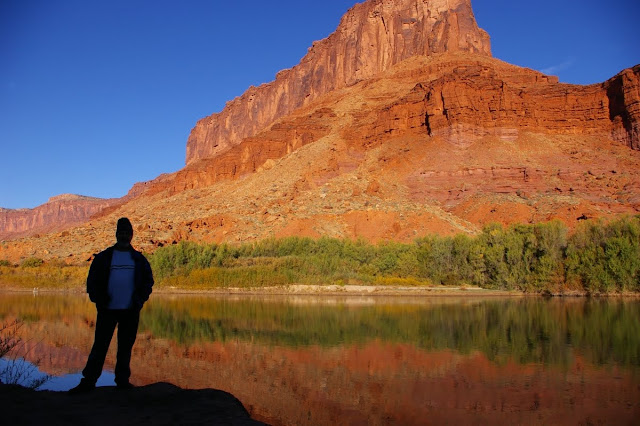
Colorado River near Moab, Utah

Saturday, May 7, 2011

The Geology of Youth (Sulfur Creek - 30 Years Later)


Capitol Reef is a geologic uplift that rises like a Great Wall through south central Utah. Running from north to south, its sandstone massif creates a formidable barrier of cliffs, canyons, domes and mesas referred to as the “Waterpocket Fold”. With its variegated ramparts, colorful gorges, and stone arches and chimneys, it more than merits its national park status.

Sulfur Creek briefly breaks free of its canyon confines near the park visitor center, flows under Utah Highway 24, then disappears into another maze of canyons just east of the road. I had not hiked along the creek since spring of 1981 but last week I had an opportunity to do so once again. I wanted to see if I could relocate a small waterfall that I had remembered from my past peregrinations in the area.

I grabbed my camera and walking stick and quickly gave the slip to several dozen Japanese tourists in and around the visitor center. I dropped into the creek bed a mere hundred yards away and immediately left humanity behind me. A brisk flow of crystal clear water was coursing through the red-walled canyon, forcing me to cross and re-cross the stream at regular intervals.

The physical landscape had changed little over the years, unlike the geography of my own aging body, full of dull aches under the skin and taking more tentative steps from rock to rock. My arthritic hands strained to hold fast to my walking stick. I grunted inadvertently each time I stooped to photograph a wildflower. More so when I tried to stand up again.

But those feelings were soon sublimated to the beauty of the canyon and by the vestiges of youth trying to reclaim my body as I drank in that golden plateau light, the spring green bursting from the undergrowth, and the magical sound of desert water. I was remembering that trip with Cindy so long ago when the two of us vagabonded for a week through the canyon country catching an unusual aurora borealis display over Arches National Park, getting caught in a rainstorm in the backcountry of Canyonlands, drinking pure water bubbling from the earth in Little Spring Canyon, and squeezing in this one last little walk in Sulfur Creek.

We were ultimately stymied at the waterfall I was now trying to relocate. Much of the canyon was still in shadow under great overhangs and alcoves. Penstemon and primrose were in bloom. And I continued my creek hopping, untroubled by human noise or presence. And in this particular case, my memory served me well.

After about half a mile I found my waterfall, cascading with a seasonal exuberance out from its sculpted bed into a broad shallow pool before pouring with renewed clarity into the main stream. I paused there by a small cottonwood tree, removed my pack, and sat down by the water’s edge.

Serenaded by the racing current, I snacked on a tangerine and a power bar, and reveled in my isolation with nature and my ability to still reach these places from my past. How much longer before that reaching is limited to mind and memory?

I sat by the waterfall in Sulfur Creek, one lone figure assailed by time in a timeless landscape, remembering those more mobile, pain-free days full of freedom and passion. And I was eternally grateful for the opportunity to return here where I could stitch my present life to the past.

Sunday, April 17, 2011

Memories of Marmaras

In the 1950s, George and Thianna Marmaras operated a produce stand on Highway 99 just north of Turlock, California. Those were the days before the highway morphed into a freeway destroying all the small farms and businesses in its path; before Interstate 5 opened up to the west to steal away commercial traffic; before Modesto, Tracy and Turlock became bedroom communities to feed the insatiable growth of the Silicon Valley; and when the Southern Pacific still ran steam engines on its Central Valley lines. Those were the days when I was still spending portions of my summers with the old Greeks in the San Joaquin Valley.

George Marmaras was already in his 70s when I knew him, a wiry little man with white hair and the dark, wrinkled skin of a farmer. His wife Thianna was a typically large, matronly woman who always wore loose cotton dresses, kept her hair in a bun and, retrospectively, reminded me of a cross between Golda Meir and Eleanor Roosevelt . She didn’t speak English as well as George but well enough to serve the occasional customer who would stop at their ramshackle stand. Both of them had been long time friends of my grandparents and, along with several other Greek families, lived within a few miles of their house.

We referred to our grandparents place as “the Farm” but it really wasn’t one in the true sense as there was no livestock or outbuildings…only acres of vineyards and peach orchard. But the Marmaras place really did seem farm-like to me. They had chickens, dogs, a goat, and great big barn. Their residence, however, was pretty tiny, even to a 10-year old boy like myself. It was a simple wood house, built in the 1920s perhaps and probably no more than 700 square feet in area. And it smelled of old wool, pleasant must and coffee.

My grandparents would always take us “visiting” to the Marmaras place at least once during the summer, usually late in the afternoon when the oppressive valley heat was starting to abate. While it was still daylight, the old folks would sit outside in the shade of an umbrella tree, eating fresh-picked grapes and watermelon and talking the melodic language of my ancestors while I explored the grounds. The Marmaras goat was confined to a small enclosure but would come close enough for me to feed it pieces of paper or any other garbage that I could find. As darkness settled in, the moths and the toads would come out and the night air would come alive with the sound of crickets and frogs.

That was when the old Greeks retired into the little house. Thianna would brew up thick Turkish coffee in a small brass pot and serve its silty residue in small cups. There would be plenty of baklava and kolouthia for dessert. The women folk (there were usually other Greek neighbors visiting as well like the Christodoulis family from nearby Keyes) gathered in the small living room and knitted and talked, knitted and talked. I never knew what about but I imagine the conversation was laced with lots of gossip and news from the old country. Meanwhile, the men sat around a small table just off of the kitchen playing loud hands of pinochle. Some of them kept their hats on the whole time, and cigarette smoke filled the room. A big jug of Cribari was always nearby.

Usually by 10pm, the last cup of coffee had been served and the pinochle game was ended, and my grandparents and I would say our goodbyes on the tiny porch and slip away into the starry valley night. Looking back now, it seems like such a faraway time, simple and uncomplicated, etched deeply into memory. How many pieces of that farm have affected my life? My love of the heat? The wide open spaces? The attachment to ramshackle buildings? Who can say. By the mid-1960s, the Marmaras farm was gone along with George and Thianna whose warmth and good humor will live on whenever I revisit those boyhood summers of the mind.

Tuesday, March 22, 2011

To Tucson & Back in Ten Paragraphs or Less


Spring Breakathon, as my daughter calls it. We lit out for the open road on Friday, headed for our ultimate destination….Tucson, Arizona. That first day took us through some mighty fine canyon country from the Colorado/Utah border where we watched pronghorns grazing in open grasslands to the southeast corner of Utah and a comfy room at the Recapture Lodge in Bluff. Along the way we drove along the Colorado River through Professor Valley, took a detour up Kane Creek Road to view petroglyphs in Moonflower Canyon, and stopped for a while to check out one of the most enduring roadside attractions…Hole In the Rock, just south of Moab.

Bluff, Utah is a curious amalgam of old Mormon stock, artists, river runners, native americans, and other assorted desert rats. In recent years it’s taken on an almost-hip aura, perhaps the only Utah town to do so. Once we settled into our little room, Lindsay and I took a walk to the banks of the ol’ San Juan River, enjoying the warm sun and solitude. Later that evening we dined at the Twin Rocks Restaurant, about the only place open for business.

However, the next morning we were fortunate enough to be able to have breakfast at Comb Ridge Coffee on the south end of town. Funky, friendly and freewheeling, the Comb Ridge is full of good vibes, old books, neat art and sculpture and, of course, the best coffee in town. Andrea, the proprietress, has a real jones for actor James Mason and his picture graces several parts of the establishment. We shared some blue corn pancakes with Leo, a retired doctor from North Carolina who spends one month a year ministering to the Navajos near Tuba City. He was on an exploring junket for the weekend so we shared some choice spots.

The remainder of the day was spent driving across the Reservation, having lunch and checking out the tacky souvenirs at Cameron, then heading into the Grand Canyon from the east through Desert View. Lipan Point was appropriately silent and spacious, but Grandview Point was full of the typical tourists running amok on the rim’s edge and overwhelming any sense of peace or place. But we met up with our friend Palma in short order and she put us up for the evening at her place on the South Rim and graciously took us to dinner at the El Tovar. We were definitely not in Colorado anymore!

In the morning I took a short drive to the Grand Canyon Village where I had to park illegally in order to get out to a view of the canyon itself. I was disappointed at the poor air quality and quickly headed back to the house. We parted ways with Palma and decided to drive all the way to Tucson without getting on the interstate. We accomplished this by heading for Mormon Lake, just outside of Flagstaff, then climbing up the Mogollon Rim to Payson and Rye, then onward to Roosevelt Lake, Tonto National Monument, and Globe where we got temporarily lost. Eventually we found the road that drops down through Dudleyville and Winkelmann to Oracle and Sue and Jack’s house at the base of the Catalina Mountains. The entire drive took seven hours.

The next four days were spent reveling in the warmth of the Sonoran Desert , if not the glorious spring colors. This has been a dry year in southern Arizona and the plants look pretty stressed. Hardly a wildflower in sight anywhere. But we enjoyed a day at the Arizona-Sonoran Desert Museum, another day hiking in Catalina State Park with my cousin Irene, another day hanging out in Old Tucson and going through the Art Museum, and the final, fantastic day walking around Sabino Canyon. Even with all the tourists (like us) running around, it was easy to find secluded places to wade in desert pools while looking up at sere hillsides bedecked in saguaros.

All too soon it was time to head back home. We made a brief stop at Pinnacle Peak near Scottsdale, then drove to Flagstaff under increasingly cloudy skies. The next day drove all the way home through dust storms and buffeting winds in Monument Valley, and around the hazy Abajos and La Sal Mountains. When I turned onto Highway 128, the River Road, just north of Moab, I felt like I was practically at my driveway.

And now it’s back to long pants and pullover shirts again as the winter still hangs on a bit in Grand Junction, but the memories of basking on boulders in Sabino Canyon and sitting by the San Juan River in Bluff will last well into the warm season. Spring Breakathon is over but Spring Equinox has arrived.

Thursday, March 3, 2011

My Happiness Epiphany


Every once in a while I chance to recall some of those rare, fleeting moments when all was exactly right with the world and the heart was so full that it seemed as if everything was shining and that all of humanity had climbed aboard the Peace Train. Those moments, for me, are like the supernovas of memory - far flung, explosive, illuminating.

There are several that come to mind almost immediately like watching Katchina dancers emerging from a kiva on a cold midnight in March at Shungapovi on the Hopi Mesas; spending a Fathers Day walking through the mud of the Paria River with my daughter Alison; hearing Country Joe & the Fish play Section 43 in person at the Avalon Ballroom in San Francisco back in 1967 with the first love of my life; sharing a morning with someone special in a Durango, Colorado ski lodge as the narrow gauge train came rumbling by; or emerging cold and wet from the Colorado River having run the rapids of Satan’s Gut in Cataract Canyon as the final rays of sun dipped down below the cliffs.

But the one moment I think of most often occurred nearly nine years ago, not long after moving to our present corner of the world. It was late in May and my wife and I and our youngest daughter Lindsay were returning from a camping trip at my old stomping grounds at Canyonlands National Park. It was the first time I had shared this special place with one of my kids, and I had delighted in watching her climb around the slickrock at Squaw Flat and explore the potholes in the sandstone above Big Spring.

But now we were heading home, driving east along Utah Highway 128, “the River Road”, that magnificent stretch of asphalt that runs along the banks of the Colorado River from Moab, Utah to the Dewey Bridge through some of the most magnificent scenery on earth. We were traversing the Professor Valley, surrounded by free standing red mesas and in view of the snow-capped La Sal Mountains. Both my wife and my daughter were asleep in the car as it gently rolled over the ups and downs of the lonely two lane road. A Mark Knopfler guitar solo was providing a musical backdrop for scenery that was so familiar to me and carried so many memories of years past. And I felt for several moments as if I were gliding through space and time, content with everything that I had and that I was and that I ever would ever be. And the tears welled up and the heart nearly burst at that one moment of absolute, pure nirvana.

But within a minute or so, I had to negotiate a sharp curve, and Amy and Lindsay woke up and began talking again, and we continued on past the Dewey Bridge and the old town of Cisco, to the fast lanes of the Interstate and the final leg of our journey home. For me, however, a cosmic needle had stitched all the threads of my life together on that one intensely familiar stretch of Utah road. And the power of that moment will stay with me for the rest of my life to be rerun through my mind whenever I need to brighten my day or put my life into real focus.

Thursday, February 3, 2011

My Big Fat Greek Television Set

I can still remember the first television set that my parents ever bought. We were living in a little house in the Sunset District of San Francisco, about four blocks from the beach. It was about 1952 and I was not yet five years old. The television was a blonde Philco console model, black & white of course. I can remember seeing part of the Democratic National Convention that year and thinking that Harry Truman was George Washington. I remember Saturday night boxing sponsored by Gillette Blue Blades. Also Ding Dong School with Miss Frances and Howdy Doody with Buffalo Bob. There was the local programming too…a guy named Captain Fortune who had puppets and showed cartoons, and a pitch man named Les Malloy. Pretty dynamic stuff.

Several years later, when the family had moved down to the Peninsula, the old Philco came with us but was eventually replaced by a color set. We got to know a local tv repair man named Mr. Hessler, a burly, blue collar type who actually would come out to our home to fix the set. He spent as much time talking to my folks about his adventures as he did repairing the television. He was a real Life of Riley kind of character. Little did he know that his job would become obsolete in another decade or so. Hopefully he had retired by then.

What brings this all to mind is my recent quest for a simple television set to replace my second-string model which recently went belly up in my basement “man cave.” It was a simple 19” Sony that I was using strictly as a monitor for transferring VHF and TIVO’ed programs to dvd. Occasionally I might sequester myself down there and actually watch a movie. In any case, one morning about ten days ago it just stopped working. So I figured I could just head to my local big box electronic store and replace it in kind.

You know the rest. They don’t make fat televisions anymore. Not even little ones. Every model I looked at had a flat panel and a high price tag. Which I can understand. Obsolescence is not a thing of the past. But I didn’t want to make a huge investment at the moment so I made a last ditch stop at the nearest Goodwill Industries store. There amidst the Radio Shack receivers, the No Name brand speakers, the well-used VCRs, and still viable cassette tape players were several lonely, little televisions of fairly recent vintage. I ended up buying a flat-fronted Emerson that looked minimally shopworn, took it home and hooked it up, and commenced my video pirating activities.

I’m not sure how long the Emerson will last but, for now, it’s got a good home in my basement. But eventually, I suppose, I will have to reconcile myself to the fact that my pudgy little appliance will go the way of Mr. Hessler, lord rest his soul.

Sunday, January 30, 2011

A Mighty Big Heart

My favorite photo of Susan was taken just a few weeks after I met her in the fall of 1973. She is sunbathing on a Big Sur creek, hugging a huge marble boulder. Embracing the earth, as it were. And very appropriate for a person who embraced life to its fullest capacity.

We’d met in the campground at Pinnacles National Monument. She was traveling alone in her green VW bus and I was a single park ranger on the make. She was easy to get close to, and so I did. I was surprised when I found out she was five years older than I was. She seemed rootless at the time, living out of that bus which was decorated with macramé, spirit catchers, pieces of shell and driftwood. A woman for the times.

Shortly thereafter we took up residence together with no thought of consequence or complication. I had a secluded house in a canyon near the park where we could enjoy the natural surroundings to the fullest. We traveled though the southwest in the fall of 1974 and I latched on to a job opportunity in the heart of Canyonlands National Park. She moved out there with me with no hesitation. We pretended to be an old married couple, and moved into a government mobile home at Squaw Flat.

The next two years were filled with an almost primal intensity as we shared the isolation and exhilaration of our red rock home. Hardly a day went by without a reminder of the splendid beauty and force of nature manifesting itself around us. Susan immersed herself in the spirituality of place. She seemed to have a supreme confidence in the goodness of man and the ability of the universe to take care of her. As for me, I hopped on the steep learning curve of a backcountry ranger, and wrestled with my own inner demons. It was inevitable that the arrangement would change in time.

One cold December morning she packed up her bus and headed south toward Flagstaff, leaving me behind in my helpless confusion and loneliness. But her upbeat spirit remained ingrained and allowed me to survive and, in time, to thrive once again.

We stayed in touch over the years as I followed her spiritual exploits in the eastern Sierras and finally to Hawaii. We swapped cards every Christmas and got caught up with each other in small increments. Until this Christmas when I received no card in return. Soon thereafter I received a note from her younger sister informing me that Susan had unexpectedly passed away last May from “an enlarged heart”.

I was surprised at first, then not so much. Susan eschewed most medical treatment. She never had a viable income or any health care. Just supreme faith. And, in the end, a very big heart. She leaves behind a very big gap in the world. One more vibrant flame of optimism and hope for humanity extinguished, but magnificent memories that will live on in me forever.

Wednesday, December 8, 2010

Ghosts of Christmas Past

Christmas was the one holiday that loomed large in our family whether it was spent at home in a plethora of package ripping or at the big Greek feast at Nany’s house in San Francisco. Either way, the holiday memories are indelibly imprinted in my mind…for good or ill.

The first Christmas I can remember was when I was six years old, living in San Francisco, and our family was privileged to get an in-person visit from a swarthy Santa Claus who looked suspiciously like my Uncle John. I bought into it though and got one of the few childhood gifts that I still have, a black bakelite Viewmaster. Another memorable yuletide occurred three years later. The family had moved down to the Peninsula by then, to the sunny climes of the South Bay. I awoke Christmas morn to find a miniature Fort Apache set under the tree, complete with plastic log walls, bunkhouse, and figures of Rusty and Rin Tin Tin.

Later Christmases were less consistent in delivering the emotional highs. In 1969 I was a student at San Francisco State, living with three other guys in a small house on 38th Avenue. Dissension had split our ranks by the time December had rolled around and the negativity was palpable. Nevertheless, Stan and I furtively drove up to Skyline Boulevard one cold, dark night and cut a scraggly redwood sapling to cheer the house up a bit. To little avail, as it turned out. The following month we all split up and moved out.

In the winter of 1975 I was living in a trailer in the Needles District of Canyonlands National Park in Utah. That year I was allowed to cut down a local pinyon pine for my tree. On Christmas Day, because of my low seniority, I was the only ranger on duty. All the rest were in Moab with their families. I got up in the morning, donned my NPS shirt, raised the flag at the contact station, patrolled an empty campground, and felt like I was the last man on earth.

Seven Christmases later I was cradling my nine-day old daughter Alison in a garret above the Olema Store in the rainy, rolling hills of the Point Reyes peninsula. Five years after that I was alone and lonely in Phoenix, Arizona.

Amy and I spent Christmas of 1996 carrying our ten-week old daughter Lindsay amid the luminarias and the aromas of posole and hot chocolate in the Old Town section of Albuquerque, New Mexico. Three years later, the three of us huddled around a small tree in the one furnished room of our newly acquired home in Las Vegas, Nevada, still adjusting to the new surroundings.

The last ten yuletide seasons have been spent in Colorado, sometimes with snow, sometimes without. All of them have been filled with warmth, love and a sense of fond ritual. But I always remember the other Christmases in other places in other times of my life. The highest highs and, sometimes, the lowest lows. If I could get just one of them back, it would be that morning I discovered the Fort Apache set on our living room floor and felt the innocence and wonder that only an untested child can know.