Ruminations From the Western Slope

Ruminations From the Western Slope
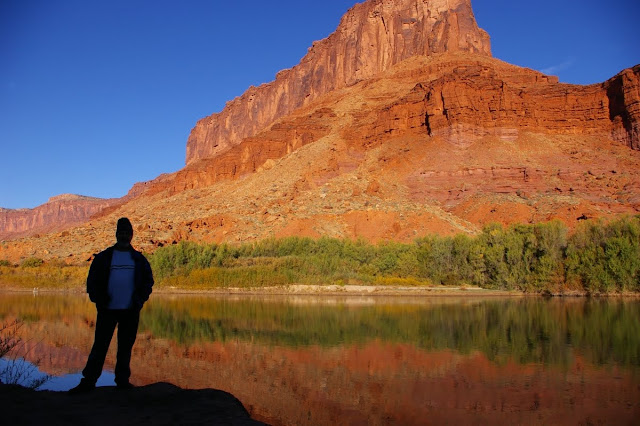
Colorado River near Moab, Utah
Showing posts with label canyons. Show all posts

Saturday, May 7, 2011

The Geology of Youth (Sulfur Creek - 30 Years Later)


Capitol Reef is a geologic uplift that rises like a Great Wall through south central Utah. Running from north to south, its sandstone massif creates a formidable barrier of cliffs, canyons, domes and mesas referred to as the “Waterpocket Fold”. With its variegated ramparts, colorful gorges, and stone arches and chimneys, it more than merits its national park status.

Sulfur Creek briefly breaks free of its canyon confines near the park visitor center, flows under Utah Highway 24, then disappears into another maze of canyons just east of the road. I had not hiked along the creek since spring of 1981 but last week I had an opportunity to do so once again. I wanted to see if I could relocate a small waterfall that I had remembered from my past peregrinations in the area.

I grabbed my camera and walking stick and quickly gave the slip to several dozen Japanese tourists in and around the visitor center. I dropped into the creek bed a mere hundred yards away and immediately left humanity behind me. A brisk flow of crystal clear water was coursing through the red-walled canyon, forcing me to cross and re-cross the stream at regular intervals.

The physical landscape had changed little over the years, unlike the geography of my own aging body, full of dull aches under the skin and taking more tentative steps from rock to rock. My arthritic hands strained to hold fast to my walking stick. I grunted inadvertently each time I stooped to photograph a wildflower. More so when I tried to stand up again.

But those feelings were soon sublimated to the beauty of the canyon and by the vestiges of youth trying to reclaim my body as I drank in that golden plateau light, the spring green bursting from the undergrowth, and the magical sound of desert water. I was remembering that trip with Cindy so long ago when the two of us vagabonded for a week through the canyon country catching an unusual aurora borealis display over Arches National Park, getting caught in a rainstorm in the backcountry of Canyonlands, drinking pure water bubbling from the earth in Little Spring Canyon, and squeezing in this one last little walk in Sulfur Creek.

We were ultimately stymied at the waterfall I was now trying to relocate. Much of the canyon was still in shadow under great overhangs and alcoves. Penstemon and primrose were in bloom. And I continued my creek hopping, untroubled by human noise or presence. And in this particular case, my memory served me well.

After about half a mile I found my waterfall, cascading with a seasonal exuberance out from its sculpted bed into a broad shallow pool before pouring with renewed clarity into the main stream. I paused there by a small cottonwood tree, removed my pack, and sat down by the water’s edge.

Serenaded by the racing current, I snacked on a tangerine and a power bar, and reveled in my isolation with nature and my ability to still reach these places from my past. How much longer before that reaching is limited to mind and memory?

I sat by the waterfall in Sulfur Creek, one lone figure assailed by time in a timeless landscape, remembering those more mobile, pain-free days full of freedom and passion. And I was eternally grateful for the opportunity to return here where I could stitch my present life to the past.

Tuesday, February 16, 2010

Silence: A Vanishing Resource

I didn’t grow up in a particularly quiet environment, but it wasn’t a particularly noisy one either. Just a normal, suburban street in Mountain View, California, not too far from the main drag of El Camino Real and safe enough to play ball in or roller skate on or ride along hands-free on my bicycle. I never gave much thought to decibel levels or ambient noise until I experienced the absence of it. That probably happened when I started camping out, but it really happened when I became a park ranger and took up residence in a national park.

That first deep winter night alone in my cabin at Pinnacles National Monument was eerily still. No cars. No airplanes. No television or radio. At first, the slightest rustle in the bushes was a startling event. A midnight squabble between two raccoons was frightening....until I got used to it. Used to the natural rhythms and soft sounds out there beyond my door. It was never complete silence but it was a natural one.

For the next fifteen years, with some minor exceptions, I was blessed with quietude. Especially when I moved to the canyon country in 1974. At Canyonlands National Park, there was silence during the day as well as the night. Sitting alone in Lost Canyon, I would be suddenly surprised by the wing beats of a raven overhead. I could hear a leaf gently falling from a cottonwood tree. Water dripping from a sandstone seep. And when I really concentrated, it seemed as if I could pick up on the constant drone of things growing. The sound of life itself. Sometimes it was a little intimidating to feel the weight of so much raw wilderness pressing against me. But I grew to love it. I got spoiled by the silence.

At Point Reyes National Seashore, the thick fog would roll in and cloak everything in its pillowy grip, muffling sounds from the sea and shoreline. Only the rutting cry of the tule elk in autumn could break through that blanket.

As my career became more urban and I moved in and out of places like Phoenix, Albuquerque, and Las Vegas I quickly realized what I had lost. Barking dogs and boom boxes became the bane of my existence. Elevator music in super markets. Chain saws on a Saturday afternoon. White noise from the freeways. And, worst of all, blaring radios in campgrounds. I could not, at first, understand why someone would come out to a campground to ostensibly experience the great outdoors, and then turn their radio up full blast.

I finally realized that, for most people, silence is not golden. It is scary. The absence of noise to a person raised on television, traffic, and telephones can be seriously disorienting. We spend so much time with some kind of constant cacophony as a soundtrack to our lives that when it suddenly ceases, a little bit of that primordial fear can set in.

But I got used to that deep and abiding silence. And I miss it everyday. And like a mole, I keep the lights dim and pad around the house in the early morning and revel in a world not quite yet awake. And when I get back into those stony canyons, I can still appreciate those little pockets of silence that punctuate an otherwise hectic life. The silence is getting harder to find and in some places is in full retreat. But for those who seek it out, it can be a resource as good as gold.

Saturday, February 6, 2010

A River Reminiscence


If there really is a heaven somewhere I hope it looks and feels like Ruby Canyon did that late October day back in 2003. There were three of us on a raft drifting in a dreamlike state through still water; through a corridor of gold and gray and red; sharing the stream with herons, ducks and eagles; and reveling in the heat of a record-breaking late October afternoon. This might have been my best day ever on the river, my moment of spiritual and emotional glory, and the summation of all the personal energy, time, romance and feeling that I have brought into this country and which this country has returned to me a hundred-fold.

We cast off from Loma launch around 9:30am, a bit late by river standards but early enough that much of Horsethief Canyon was still in shadows and as the sun crept into the cottonwood galleries, they would ignite with an almost holy luminescence like torches lighting the way through this watery corridor. Ahead of us, the upper cliffs and buttes were bright with morning light while the canyon mouths waited in cool darkness. A few miles downstream we stopped at the mouth of Rattlesnake Canyon where we exited the raft, and followed the primitive trail up-canyon in search of slickrock. Every turn in the trail brought some new delight. A fresh view. A blazing red squawbush. An eroded alcove. Giant monolithic structures. We soon reached a stony corridor which was still in the shade, a beautifully sculpted section of creek where the gravel and soil had long since been removed, leaving a slickrock staircase through narrow walls. We hung out there for quite a while before returning to the raft.

By then it was nearly noon and we had barely begun the trip. So we pressed on downstream, skirting riffles and eddies, amazed and humbled by the steadily rising cliffs. I sat at the front of the raft, taking it all in, trying to somehow imprint the landscape on my brain, knowing that this could be the last trip I take on the river for quite some time. A float trip always has its own time schedule. The current dictates where you go and how fast you get there. No point in worrying about a time schedule. The scenery slides by at a slow pace massaging the senses as it does. Your eyes fix on a point downstream and that point approaches at an even, minimal pace allowing you to study it, anticipate it, dissect it if need be. The immediate banks of the river move by like the old multi-plane animations of Walt Disney. A cottonwood looms ahead. The view of it then replaced by rising tamarisk. Then a butte rises up from nowhere. And then, in a single instant butte, cottonwood, and tamarisk are all framed exquisitely to the human eye. This is the recurring cycle of floating downstream.

We took a late lunch on the Mee Canyon Bench which was rife with autumn-heavy trees offering shade while framing the surrounding cliffs with great, arching branches and sweeping canopies. We marveled at the absence of any other people. No other floaters. No trains coming through. No hikers. Not even any airplane noise. I fell into deep reminiscence as I sat beneath a mother cottonwood eating my lunch. I thought about Octobers past. I mentally walked myself though all the trails walked, and mesas climbed, and arroyos explored in my thirty-odd years out here. How much sand had accumulated in my shoes? How much red dust in my teeth? How many friends had I taken with me? I felt like I knew so much yet still knew so little about this place, but I felt a peace and comfort verging on nirvana. I felt my life coming full circle in canyon country.

It was after two by the time we got back on the river and now the sun had drifted substantially to the west, sending long shadows across the rocks. As we navigated the whirlpools and rough water of Black Rocks, the Precambrian, polished stone captured and reflected the afternoon light. The rocks loomed out of the water like thick, black icebergs as we moved through the narrow, foam-flecked channel. As we headed west into the sunlight itself, I basked in the heat and the deep blue sky above. In a few more miles, we would transition from the inner depths of Ruby Canyon to the more open shorelines near the Utah/Colorado border.

As soon as one reaches the state line, the river breaks free of the canyon's constraints and enters a broad, brilliant country of free standing buttes, open fields, and thickening cottonwood galleries. With the sun now behind them, the trees were afire with yellow and orange. Along the banks, the squawbush glowed red, while the thick tamarisk stands were haloed in a coppery glow. The overall feeling was one of leaving a great cathedral and ascending to the very portals of a heavenly landscape. Not a single mile was lost on my senses. I drank it in. I stored it. I reveled in it. And I silently congratulated myself for knowing when to take this trip. For having the experience and foresight to time it so perfectly. And I thanked the canyon gods for cooperating with great weather, great colors and great companionship. That day on the river was a distillation of all the Octobers ever spent on the Colorado Plateau, a concentrated dose of all the best this land can offer. I never tire of it. I never fail to be renewed by it. I have a canyon lands dependency.