Ruminations From the Western Slope

Ruminations From the Western Slope
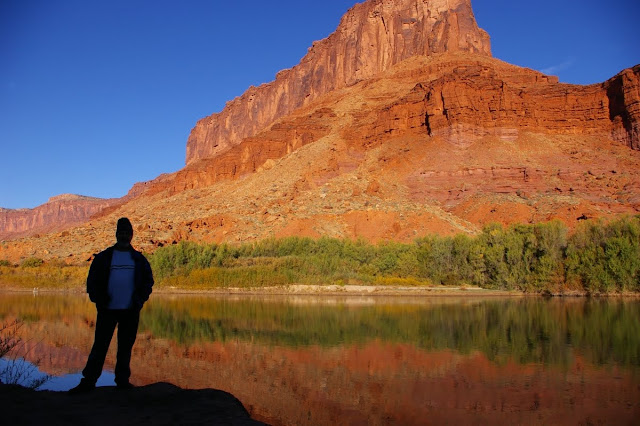
Colorado River near Moab, Utah
Showing posts with label utah. Show all posts

Saturday, May 7, 2011

The Geology of Youth (Sulfur Creek - 30 Years Later)


Capitol Reef is a geologic uplift that rises like a Great Wall through south central Utah. Running from north to south, its sandstone massif creates a formidable barrier of cliffs, canyons, domes and mesas referred to as the “Waterpocket Fold”. With its variegated ramparts, colorful gorges, and stone arches and chimneys, it more than merits its national park status.

Sulfur Creek briefly breaks free of its canyon confines near the park visitor center, flows under Utah Highway 24, then disappears into another maze of canyons just east of the road. I had not hiked along the creek since spring of 1981 but last week I had an opportunity to do so once again. I wanted to see if I could relocate a small waterfall that I had remembered from my past peregrinations in the area.

I grabbed my camera and walking stick and quickly gave the slip to several dozen Japanese tourists in and around the visitor center. I dropped into the creek bed a mere hundred yards away and immediately left humanity behind me. A brisk flow of crystal clear water was coursing through the red-walled canyon, forcing me to cross and re-cross the stream at regular intervals.

The physical landscape had changed little over the years, unlike the geography of my own aging body, full of dull aches under the skin and taking more tentative steps from rock to rock. My arthritic hands strained to hold fast to my walking stick. I grunted inadvertently each time I stooped to photograph a wildflower. More so when I tried to stand up again.

But those feelings were soon sublimated to the beauty of the canyon and by the vestiges of youth trying to reclaim my body as I drank in that golden plateau light, the spring green bursting from the undergrowth, and the magical sound of desert water. I was remembering that trip with Cindy so long ago when the two of us vagabonded for a week through the canyon country catching an unusual aurora borealis display over Arches National Park, getting caught in a rainstorm in the backcountry of Canyonlands, drinking pure water bubbling from the earth in Little Spring Canyon, and squeezing in this one last little walk in Sulfur Creek.

We were ultimately stymied at the waterfall I was now trying to relocate. Much of the canyon was still in shadow under great overhangs and alcoves. Penstemon and primrose were in bloom. And I continued my creek hopping, untroubled by human noise or presence. And in this particular case, my memory served me well.

After about half a mile I found my waterfall, cascading with a seasonal exuberance out from its sculpted bed into a broad shallow pool before pouring with renewed clarity into the main stream. I paused there by a small cottonwood tree, removed my pack, and sat down by the water’s edge.

Serenaded by the racing current, I snacked on a tangerine and a power bar, and reveled in my isolation with nature and my ability to still reach these places from my past. How much longer before that reaching is limited to mind and memory?

I sat by the waterfall in Sulfur Creek, one lone figure assailed by time in a timeless landscape, remembering those more mobile, pain-free days full of freedom and passion. And I was eternally grateful for the opportunity to return here where I could stitch my present life to the past.

Wednesday, January 27, 2010

Bridging the Years

My first encounter with the Dewey Bridge was just before Christmas of 1974. As a young park ranger, I had moved to the Needles District of Canyonlands just two months earlier. Awed and slightly intimidated by the remoteness, I quickly adapted to the 160 mile round-trip drive to and from Moab, Utah to buy groceries, pickup mail, make phone calls, and mingle with humanity a bit. At that time, the Atlas Uranium Mill was in the process of shutting down and Moab was a depressed area. People were actually moving away and the population hovered around 4,000.

Services were limited. No liquor, of course (this was still a Mormon town). No book stores, clothing stores, record stores. There was a small Sears Catalog store across the street from the post office where I once ordered a Super 8 film projector so that I could show old movies back in the District. Most everyone I knew said that to do any real shopping, I’d have to go to Grand Junction, Colorado, another 100 miles up the road.

And the best way to do that was to take Utah Highway 128, the River Road. When I discovered the River Road, I discovered a road into my soul. Back then it was a narrow, partially paved ledge that meandered along the banks of the Colorado River, flanked by high red walls of Wingate sandstone, breaking out occasionally into small valleys like the Professor Valley where Fisher Towers, Castle Rock and other stone monoliths stood guard along the edges.

Much of the road was still unpaved including the stream crossings at Onion Creek and Professor Creek where one simply splashed on through. And then, of course, about 28 miles east of Moab, there was the Dewey Bridge, a solid little wooden structure at a sharp bend in the road where a sign warned it was a one-way crossing. It was a narrow bridge even for my little 1973 Datsun pickup. But what an adventure for a boy from the bay area.

For four years I bonded with the River Road and always had a special sense of anticipation at crossing the Dewey Bridge. In 1985 a modern concrete bridge was constructed but the historic Dewey Bridge remained as a footbridge and a palpable reminder of a not-so-distant frontier past. When I returned to the area in 2001, I quickly re-established my relationship with the River Road and the old bridge.

In the spring of 2008, a young boy playing with matches downstream ignited the dry tamarisk along the river bank and the fire rapidly spread upstream where it took out the old bridge, leaving nothing but dangling cables and supports. There is talk of rebuilding it someday but it won’t be the same. Losing the bridge was like losing an old friend.

Tuesday, January 26, 2010

Under the Influence of the Confluence

The meeting of two rivers is not unlike that magical afterglow when two lovers have conjoined for the first time. On the surface all is mostly placid and calm while beneath the surface the currents roil and intermingle. The two rivers become one as they move downstream. They collectively carry the silt, the sand, the shoreline momentoes with them as they glide along. Together now they will experience calm spots and stretches of rough water.

I currently live in a town whose name celebrates the confluence of two great western rivers, the Gunnison and the Grand (now called the Colorado). Grand Junction was so named in 1881. Yet that very confluence is difficult to find anymore, merging as it does in the heart of a forgotten industrial area, below dilapidated private lots. There is no trail to the site. No overlook. You might be able to catch a glimpse of it from the old railroad bridge. But it is not an advertised destination...

...Unlike the confluence farther downstream where the Colorado and Green Rivers meet in the heart of Canyonlands National Park in Utah. For four years of my life, in the late 1970s, I had the privilege of living just a few miles from the spot, in an enclave of National Park Service trailers in the Needles District of Canyonlands. I saw the Confluence often, at least several dozen times a year when I would patrol the back side of Elephant Hill through terrain of the roughest and most beautiful kind.

The Confluence was a major park destination because first-time visitors had different expectations about what they might see out there, thinking that they would gaze down into a gorge and see a wild, frothing mist arising from the collision of two mighty, churning waterways. Their expectations would grow as they endured the rugged, 4-wheel drive and the final half mile hike to the brink where they would be confronted with........sublime silence, solitude and space.

One thousand feet below them, in the midst of an austere landscape of layered rocks and eroded landforms, were the seemingly still, sinuous ribbons of the two great rivers, the redder Colorado flowing in from the northeast and meeting the pea-soup green Green curving down from the northwest. Depending on the time of year, the stronger and larger Colorado would capture the colors of the Green and subdue them quickly, continuing its muddy red flow to the south.

In spite of the lack of frothing drama below, visitors were seldom disappointed. After all, there they were at one of the loneliest overlooks on the continent in a landscape the human mind could barely conceive of, looking down....and up...and around. And experiencing maybe for the first time that sublime silence, solitude and space.