Ruminations From the Western Slope

Ruminations From the Western Slope
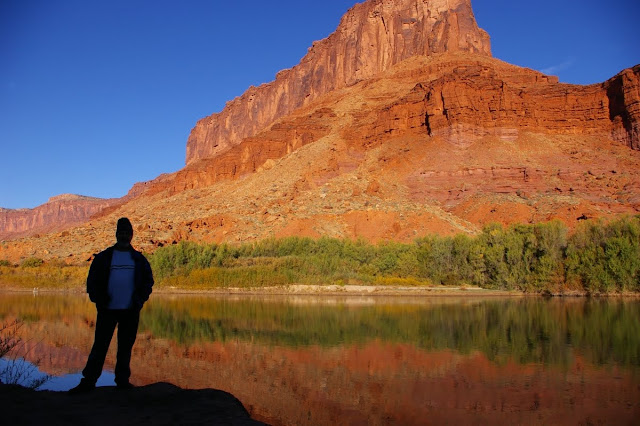
Colorado River near Moab, Utah
Showing posts with label national parks. Show all posts

Sunday, August 21, 2011

Frogs in the Desert

I love this country! The Colorado Plateau, that is. It is early morning in Capitol Reef, Utah and I am watching the sunlight slide down the nearby cliffs, illuminating them in hues of apricot and vermillion. Got a hot cup of dark coffee in my hands, and my daughter Lindsay is still asleep in the tent.

Today we drive over the high country of the Henry Mountains through the slickrock domes of the Escalante, to Bryce and Zion Canyons and, eventually, to Kanab, Utah. Yesterday we got wet and muddy in the waters of Sulfur Creek and I watched as Lindsay sloshed through the stream and clambered over tumbled boulders, all smiles and increasingly confident in her hiking abilities.

I first came to this country forty four years ago with a busload of geology students from Foothill College, all fresh faced and eager. Most of what I knew about the desert southwest was what I had seen in low-budget westerns. You know, all those cool rocks the cowboys would hide behind to shoot at other cowboys who were riding past Joshua trees, all conveniently located not far from Hollywood in the Mojave Desert.

But that geology trip was a revelation to me. In nine days we went from digging trilobites in the Marble Mountains of California to hiking to the bottom of the Grand Canyon and back out again (with a night of revelry on the Colorado River in between), to visiting Indian ruins at Wupatki in Northern Arizona…and then to the red heart of the Colorado Plateau at Zion National Park. As I watched a nearly full moon rise over the Great White Throne, I knew that I would one day return.

And here I am. Beguiled visitor to the plateau’s western edge and full-time resident on the plateau’s eastern edge. I never lose my fascination and awe for the swirled sandstone, sinuous canyons, and hidden pockets of water. If all goes well this afternoon, we will sneak into a secret little canyon of mine on Zion’s east rim where quiet emerald pools are cradled by rock basins, landscaped with wiry shrubs and patches of wild fuchsia and paintbrush. In and out of the waterpockets are the desert tree frogs, neatly camouflaged denizens of pothole and pool. Life on a small scale in a landscape of a mighty scale.

After four decades the magic is still there. The fascination. The anticipation. Made even more significant by the company of my own child who lives in the moment in the landscape of her father’s past.

Monday, April 5, 2010

INTO THE MILD - Conclusion


March 21 - I have never regretted being an early riser. There is something almost holy about going out into a world still mostly asleep and catching the first deep lavender makings of dawn on the eastern horizon. There is an optimism about starting a new day. And there is opportunity for us shutterbugs who need to catch that first, golden light.

And so it was with me. I was packed and out of the campground before sun up. As I proceeded south along the eastern edge of Death Valley, I watched that first light hit the top of the Panamint Range, highlighting the snowcapped Telescope Peak (at 11,000’+ the highest point in Death Valley). I had sixteen miles between me and Badwater so I took it slow and easy on the curvy two-lane road. Along the way, I saw my first Death Valley wildflowers, a large array of brown-eyed evening primrose. When I finally pulled into an empty Badwater parking area, I was the only human anywhere in sight. and the lighting was just about as perfect as I could wish for.

There were only two minor logistical problems. Due to resource damage from the hordes of people who now regularly descend upon the salt flats here, the National Park Service built a raised boardwalk several years ago which allows for a decent view of the lowest point in the United States but intrudes itself into the reflecting salt pools. Furthermore, there are several emphatic signs admonishing visitors to not get off of said boardwalk. This makes capturing the classic morning view of the pools well nigh impossible anymore. With a bit more thought, the boardwalk could have been more optimally placed but such is sadly not the case.

Well, I am an early riser. And there clearly was not another human being within several miles. So I gingerly stepped off the boardwalk and trod as lightly as I could to a point where I could capture that fabled reflection of the Panamints in the salt pool. By squatting at just the right spot, I was able to lose the boardwalk off the left hand frame and get a close approximation of the picture I had wanted so badly....not perfect by any means but still pretty impressive. I have to point out that I was not being cavalier about this because I am an ex-ranger and feel somehow privileged to break park rules. But sometimes regulations need to bent just a little bit if one knows that no real damage is being done.

I rattled off several frames before returning to my car and continuing the long, leisurely drive toward Jubilee Pass. Along the way I was treated to more patches of primrose, and great sweeping vistas of salt flats, standing water reflections, fat green creosote bushes, and broad alluvial fans swooping down from the Panamints. I gloried in the quintessence of Mojave desert as I climbed over Jubilee Pass toward Shoshone. I was so energized that I ended up driving all the way to Kanab, Utah that night and all the way home to Grand Junction, Colorado the following day.

Behind me I had put the haunting hoodoos of the Paria Plateau, the snowy stretches of Zion’s east rim, the mysteries of Wash #5 in the Valley of Fire, the almost incomprehensible wildflower displays of the Carrizo Plain, and the craggy crescendo of Death Valley itself. In between were the quirky cafes, cheap hotels, bucolic towns and abandoned homesteads that enhanced the journey. And most of all, I got to feel the warm sun I so desperately missed through the long Colorado winter. And as I write this, the skies are once again clouding up and threatening more rain and snow. God bless the Mojave and the Great American deserts! Long may they remain!


INTO THE MILD -Part Seven


March 20 - The older I get the harder it is for me to sleep on the ground, a sobering admission from an ex-park ranger who used to be able to sleep just about anywhere. But I’ve got the car camping thing down pretty well now. I’ve got a small foam pad, my sleeping bag, and a pillow. And with the back seats folded down, I can sleep comfortably in the back of the Subaru in a diagonal, moderately fetal position. I’ve got my reading light, my books, and a few extra odds and ends. And when I shut the car doors, I also have silence. In the full-to-the-max Texas Spring campground, where every manner of thoughtless camper was staying, this was a good thing. Once inside the car, I could not hear the barking dogs, the motorcycles, or the crying kids. I got out my portable dvd player and watched an old episode of Mystery Science Theater 3000, and I was a happy camper.

Determined to get the jump on said campers and tourists, I lit out the following day at the first light of dawn for the trail head at Golden Canyon. The place really lived up to its name too as the amber light of the first official day of spring seeped down its cream-colored slopes. It was an easy walk up a rocky, shaded wash. The hills above literally glowed in the morning sun. And there were numerous little side canyons to divert my attention as well. When I emerged from the canyon about 90 minutes later, the parking lot was already full....and I had had my fill of Golden Canyon.

I wanted to see the hills of Golden Canyon from above so I took the east road past Furnace Creek Resort on up to the overlook at Zabriskie Point. From there I could see Manly Beacon and the crinkled badlands below. There I met Debra, another photography addict, who was raised in Pahrump, Nevada and we talked about digital technology for awhile and I had her take my photo at the overlook.
Later that day I took on Mosaic Canyon, a similar but less visited area near Stovepipe Wells whose marble walls have been polished by eons of flash flooding, and where varied bits and pieces of colorful stone conglomerate have formed the “mosaic” designs. Death Valley is nothing if not colorful. True, there is a decided lack of the color green but, otherwise, the ocher, maroon, lavender, vermilion, umber, saffron landscape is in constant flux as light and shadow play across its creases and folds.

For true green, one can spend some time at Furnace Creek which is where I stopped on my way back from Mosaic Canyon. The stores, resort, golf course, gas station and other developments attract hordes of tourists and today was no exception. For awhile, I found a spot beneath some huge date palms where I tried reading more of The Big Sleep but the noise of traffic and humanity was more than I could bear and I returned to my campsite.

I knew that I would be leaving Death Valley the following day and I was determined to get on the road before dawn. My goal was to be at Badwater just at sunrise to get the classic view of the sunlit Panamint Range reflected in the salty pools at the lowest spot in the continental United States. So I retired early into my little car cubicle and made ready for the final leg of my trip home.

Sunday, April 4, 2010

INTO THE MILD -Part Six


March 19 - I bid an early morning farewell to the Econo Lodge and eagerly left Mojave behind, driving north on Highway 14 toward Ridgecrest. This is not the consummate desert drive, by any means but a long, barren stretch of roadway flanked by the Tehachapi Mountains to the west and miles of creosote flatlands to the east. At the nearly deserted crossroads of Olancha, one turns east on highway 190 which follows the south shore of Owens Dry Lake. This is a lake that used to be a vital waterway before being diverted in the early part of the 20th century to support the burgeoning city of Los Angeles. Now it is just a dusty white sheet across the landscape.

As with Zion National Park, this week marked the 43rd anniversary of my first visit to Death Valley which was part of a geology field class out of Foothill College in the spring of 1967. My first ever glimpse of southwestern deserts and the beginning of a lifelong love affair. For some people, Death Valley may be the hardest of all American deserts to love. It is certainly the harshest and most intimidating. That includes the narrow, winding route from the west which climbs over the Argus Range, drops steeply into the Panamint Valley, climbs again over the Panamint Range, then drops even more steeply into Death Valley itself. The temperature at 5,000’ Towne Pass was 53 degrees. By the time I reached Stovepipe Wells, near sea level, it was a warm 75 degrees. Just before I reached Furnace Creek, a lone coyote loped across the road in front of me. It was almost as if he was the official greeter.

The one thing I had not anticipated was just how many other people might have the same idea as I did about getting away to some hot desert country. The campgrounds in the Valley were all pretty crowded, and Furnace Creek was alive with activity. By the time I got to Texas Spring, there were only about six pathetic sites left. So I took the least pathetic of the lot, a 200’ square foot chunk of gravel across from the campground host, the restroom, and a telephone booth. It was a real comedown from my bucolic space at the Carrizo Plain, but I vowed to make the best of it. After all, it was now nearly 85 degrees and I was wearing shorts and a t-shirt for the first time in months.

I spent the remainder of the afternoon driving south to Badwater which was bad for lighting and bad for solitude at the moment. Lots of folks scrambling around on the salt flats. Artists Drive was busy as well, and the trail head parking at Golden Canyon was nearly full. So I repaired to Furnace Creek for a few supplies, then returned to my campsite where I found shade in the shadow of the Subaru and started reading Raymond Chandler’s The Big Sleep. I figured I would pass the time until dusk when I could drive back out to Stovepipe Wells and catch the optimum light on the sand dunes.

It is a nearly 30 mile drive back to Stovepipe Wells from Texas Spring but I timed my arrival pretty well as the shadows were lengthening on the dunes. I avoided the official parking lot where tourists were climbing like ants all over the sand and marring the dune patterns. Instead I went down the road a bit farther, parked on a shoulder, and walked in from a less utilized location. I spent the next forty minutes or so wandering through the mounds and hummocks of sand, photographing ripples, mud cracks, and shadowed slopes. I was not disappointed.

By the fading light of dusk, I headed back to my campsite, mesmerized by the multicolored landscape. I vowed to get up early the next morning and beat the crowds to some of my favorite spots.

Tuesday, February 16, 2010

Silence: A Vanishing Resource

I didn’t grow up in a particularly quiet environment, but it wasn’t a particularly noisy one either. Just a normal, suburban street in Mountain View, California, not too far from the main drag of El Camino Real and safe enough to play ball in or roller skate on or ride along hands-free on my bicycle. I never gave much thought to decibel levels or ambient noise until I experienced the absence of it. That probably happened when I started camping out, but it really happened when I became a park ranger and took up residence in a national park.

That first deep winter night alone in my cabin at Pinnacles National Monument was eerily still. No cars. No airplanes. No television or radio. At first, the slightest rustle in the bushes was a startling event. A midnight squabble between two raccoons was frightening....until I got used to it. Used to the natural rhythms and soft sounds out there beyond my door. It was never complete silence but it was a natural one.

For the next fifteen years, with some minor exceptions, I was blessed with quietude. Especially when I moved to the canyon country in 1974. At Canyonlands National Park, there was silence during the day as well as the night. Sitting alone in Lost Canyon, I would be suddenly surprised by the wing beats of a raven overhead. I could hear a leaf gently falling from a cottonwood tree. Water dripping from a sandstone seep. And when I really concentrated, it seemed as if I could pick up on the constant drone of things growing. The sound of life itself. Sometimes it was a little intimidating to feel the weight of so much raw wilderness pressing against me. But I grew to love it. I got spoiled by the silence.

At Point Reyes National Seashore, the thick fog would roll in and cloak everything in its pillowy grip, muffling sounds from the sea and shoreline. Only the rutting cry of the tule elk in autumn could break through that blanket.

As my career became more urban and I moved in and out of places like Phoenix, Albuquerque, and Las Vegas I quickly realized what I had lost. Barking dogs and boom boxes became the bane of my existence. Elevator music in super markets. Chain saws on a Saturday afternoon. White noise from the freeways. And, worst of all, blaring radios in campgrounds. I could not, at first, understand why someone would come out to a campground to ostensibly experience the great outdoors, and then turn their radio up full blast.

I finally realized that, for most people, silence is not golden. It is scary. The absence of noise to a person raised on television, traffic, and telephones can be seriously disorienting. We spend so much time with some kind of constant cacophony as a soundtrack to our lives that when it suddenly ceases, a little bit of that primordial fear can set in.

But I got used to that deep and abiding silence. And I miss it everyday. And like a mole, I keep the lights dim and pad around the house in the early morning and revel in a world not quite yet awake. And when I get back into those stony canyons, I can still appreciate those little pockets of silence that punctuate an otherwise hectic life. The silence is getting harder to find and in some places is in full retreat. But for those who seek it out, it can be a resource as good as gold.

Tuesday, January 26, 2010

Under the Influence of the Confluence

The meeting of two rivers is not unlike that magical afterglow when two lovers have conjoined for the first time. On the surface all is mostly placid and calm while beneath the surface the currents roil and intermingle. The two rivers become one as they move downstream. They collectively carry the silt, the sand, the shoreline momentoes with them as they glide along. Together now they will experience calm spots and stretches of rough water.

I currently live in a town whose name celebrates the confluence of two great western rivers, the Gunnison and the Grand (now called the Colorado). Grand Junction was so named in 1881. Yet that very confluence is difficult to find anymore, merging as it does in the heart of a forgotten industrial area, below dilapidated private lots. There is no trail to the site. No overlook. You might be able to catch a glimpse of it from the old railroad bridge. But it is not an advertised destination...

...Unlike the confluence farther downstream where the Colorado and Green Rivers meet in the heart of Canyonlands National Park in Utah. For four years of my life, in the late 1970s, I had the privilege of living just a few miles from the spot, in an enclave of National Park Service trailers in the Needles District of Canyonlands. I saw the Confluence often, at least several dozen times a year when I would patrol the back side of Elephant Hill through terrain of the roughest and most beautiful kind.

The Confluence was a major park destination because first-time visitors had different expectations about what they might see out there, thinking that they would gaze down into a gorge and see a wild, frothing mist arising from the collision of two mighty, churning waterways. Their expectations would grow as they endured the rugged, 4-wheel drive and the final half mile hike to the brink where they would be confronted with........sublime silence, solitude and space.

One thousand feet below them, in the midst of an austere landscape of layered rocks and eroded landforms, were the seemingly still, sinuous ribbons of the two great rivers, the redder Colorado flowing in from the northeast and meeting the pea-soup green Green curving down from the northwest. Depending on the time of year, the stronger and larger Colorado would capture the colors of the Green and subdue them quickly, continuing its muddy red flow to the south.

In spite of the lack of frothing drama below, visitors were seldom disappointed. After all, there they were at one of the loneliest overlooks on the continent in a landscape the human mind could barely conceive of, looking down....and up...and around. And experiencing maybe for the first time that sublime silence, solitude and space.