Ruminations From the Western Slope

Ruminations From the Western Slope
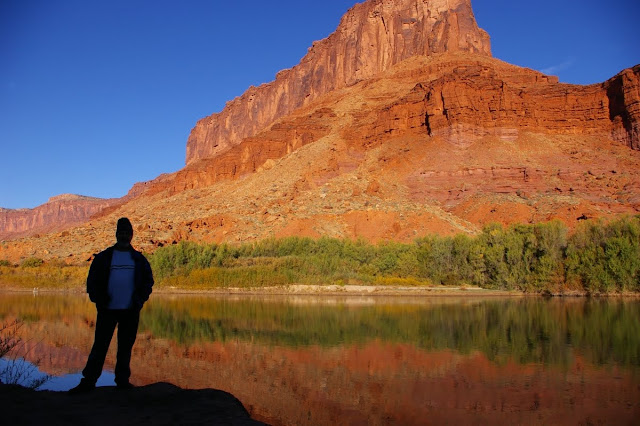
Colorado River near Moab, Utah

Sunday, July 11, 2010

Breakfast at Bella's


There isn't much happening at 5:30am in Wells, Nevada but for a hearty breakfast, check out Bella's Cafe. That's what the campground host at Angel Creek Campground told me. I had left Grand Junction the day before and driven 470 miles to this rather lonely outpost on the northernmost slopes of the Ruby Mountains. I had caught the first light of dawn on the Bookcliffs near Thompson, Utah; skirted the urban mess of Provo and Salt Lake; and finally reached true Great Basin terrain at this little Forest Service Campground.

I needed to get an early start to continue my trip westward and Bella's was the only game in town. I was their first customer that morning, greeted by a cheery dark waitress who looked like she might have native american/hispanic roots. Black hair. Black t-shirt. Pushing 40 maybe. Difficult to say how hard her life might be in Wells.

From the outside, Bella's looks like any other dive you might see by the side of an Interstate. Inside the same. Tacky gift shop. Free shoppers guide at the entrance. The usual suspects.

But Pink Floyd's Dark Side of the Moon was piping out from the radio when I got my hearty breakfast of over-easy eggs with some homemade green chile sauce on the side; sausage links; and real home fried potatoes. And lots of them. Plus home made apple butter, not the gelatinized, tasteless stuff that comes in those little square plastic containers. And, damn, if the coffee wasn't excellent! I felt I had discovered something special in an otherwise ordinary little burg.

One wonders how folks get by in these isolated little towns. The interstate traffic keeps them going somehow. People like me, weary from the road, and looking for a good solid meal. That one breakfast kept me going for another 600 miles, through Winnemucca and the volcanic tablelands of northern Nevada and southern Oregon; into the Cascade region and that first breathtaking glimpse of Mt. Shasta, into the hot heart of California's Central Valley at Redding. I'm not sure I could have done it without Bella's. The next time you're in Wells, Nevada, check it out!

Wednesday, June 16, 2010

The New Mexico of Memory

When we crossed into New Mexico from Colorado two weeks ago, I swear that the sky suddenly changed, taking on a clarity and depth not found anywhere else. We journeyed over rolling high hills dotted with pines, took in little towns like Tierra Amarilla and Los Ojos, photographed crumbling adobes, and stopped at roadside churches. And all the while there was that deep blue sky overhead. It stayed with us as we descended from Chama into the badlands around Ghost Ranch where we camped for the night in a nearly deserted campground, surrounded by pinyon and juniper and Georgia O’Keefe’s colorful cliffs.

We lived in Albuquerque in the late 90s while I rangered away at Petroglyph National Monument, one of those politically created parks that should have been given to the city to manage instead of the Department of Interior. By the time I got there in 1994, the burgeoning tract homes had already been built right up to the volcanic escarpment on which most of the petroglyphs had been carved. There were literally petroglyphs in peoples’ backyards. The City of Albuquerque hated the park because it was an impediment to further development. Later political machinations by Sen. Domenici allowed a corridor to be removed from the park boundary and made available for a four-lane highway in order to facilitate development on the west mesa.

As a result, these “sacred images” carved in stone now look down upon strip malls, neighborhoods, and gridlocked traffic. There are few places where one can experience the actual context in which these images were made. To add insult to injury, in 1997 a new superintendent took over the reins of the monument and immediately alienated the entire park staff. A woman with a chip on her shoulder and a hatred of white males. Despite our pleas to upper management over the next couple of years, little was done to curb the lying, deception and abuse. I saw the writing on the wall and got out at the end of 1998. Leaving New Mexico was one of the hardest things we ever did.

And that superintendent......She eventually got caught using her government credit card to pay off gambling debts and was removed and demoted (anyone else would have been fired). I went on to bigger and better things with the Bureau of Land Management at Red Rock Canyon in Nevada.

But being back in New Mexico again two weeks ago was still a bit of heaven. We gorged ourselves on cultural and tourist sites in Albuquerque, attended a festival in Santa Fe, and ate lots of green chili. We took the High Road to Taos through little towns like Nambe, Chimayo, Truchas and Las Trampas....towns that have changed little over the years and still reflect the rural Hispanic culture when you look between the art galleries and get off of the beaten path.

So maybe the sky really didn’t change at the Colorado/New Mexico border but my emotions certainly did. We were back in a place we had called home. The place where we honeymooned. The place where our daughter was born. A place that is truly the Land of Enchantment.

Monday, June 14, 2010

Got Thoughts?

I am beginning to realize that we live in a society that rewards and reveres ignorance as typified in the rise in popularity of shows like The Biggest Loser, Are You Smarter Than a 5th Grader?, America’s Got Talent and anything on FOX News. Something in the American psyche takes a morbid interest in seeing others being humiliated and disgraced on national media. Or seeing the smart guy get his come-uppance. It’s often been referred to as the “dumbing down of America” but I believe it is much more sinister than that. It is a calculated, organized attempt to create an ignorant and passive electorate, a society of rubes and reactionaries who will dutifully fall at the feet of right wing ideologues and super-patriots.

On the one hand we are fed the seemingly earnest platitudes from politicians about the importance of education to our youth and the ultimate goal of producing college graduates, yet as soon as those students obtain a degree they are labeled as “intellectuals” and summarily reviled by the conservative right. It’s better, after all, to find Jesus and embrace family values than to be “an educated fool”. So we elevate the status of the Sarah Palins and Glenn Becks while at the same time diminishing the contribution of scientists, writers, educators and artists. We worship a fabric flag instead of concrete knowledge; blind aggression over quiet reason.

This is nothing new, of course. But I worry that it has become so pervasive in this country. There are the obvious parallels to the rise of Nazi Germany and other authoritarian regimes, but these seem to take a back seat to the continued pursuit of capitalism at any cost, rampant racism, and unbridled jingoism.

This may come as a shock to many but America may not be the greatest country on the planet. It might be New Zealand or maybe Sweden or maybe some small isolated island with a more balanced view of cultural diversity, environmental integrity, and intellectual stimulus. And that’s okay with me. I don’t care if we are not number one. I’d rather live in a country that seeks progressiveness, respect, and compassion for its population. How do we get back to that? Or were we ever there to begin with?

Wednesday, May 19, 2010

A Passion for Books


I love books. I have surrounded myself with books all my life. I love the feel of them. I love the way they look on a bookshelf. I love all the information that they hold. And I love the quiet dignity they give to our otherwise ramshackle house. I have so many books that over the past few years, I have taken to selling off a few of them (http://www.alibris.com/stores/westslopebooks). I haunt used book stores; wait for Friends of the Library sell-offs; ferret out yard sales; all in the hopes of finding some special treasure or unique volume. For me, the thrill is in the hunt.

A couple of years ago I found a first edition of John Steinbeck’s East of Eden which I bought for 50 cents at a yard sale and sold for $200. Another time I picked up the original two-volume set of Ullyses S. Grant’s autobiography which is worth close to $400. I got it for a buck. Then there was the first edition copy of Richard Farina’s Been Down So Long It Looks Like Up to Me which was published just weeks before his untimely death on a motorcycle. After paying 25 cents for it, I reluctantly sold it last year for $200.

Of course, for every success story like these there are dozens and dozens of mediocre finds; piles of Readers Digest condensations, romance novels, born-again Christian books, and old sets of encyclopedias. But for me, it is worth diving through the dreck if I can find just one worthwhile title. Whether I end up selling it or not is almost immaterial. I am determined to keep an eclectic and esoteric inventory that I can be proud of.

What brought this subject to mind is the increasing number of book hunters I am seeing now at yard sales who are relying on hand held computers that scan the books’ ISBN numbers and give an immediate value. I watch as these people pick up title after title, barely looking at it, and quickly scan the number on the back. They show no interest in what is inside the book; spend no time mulling over subject or author. Just a quick scan and it either goes in the bag or back on the table. It is a fast and soulless operation.

For these book hunters, the search is simply for the money. There is no passion involved. No curiosity beyond the book’s worth. Profit or not, I could never collect books in this manner. Fortunately, from my standpoint, there is very little competition involved. Most of the books I look for were published long before the advent of ISBN numbers. And I pride myself on having a degree of knowledge in my own mind as to what is of value and what is not. Often I may buy a book simply for its esthetics or content with no intention whatever of selling it.

I may spend a lot more time sifting through the piles of pages then these merciless scanners do, but I get so much more satisfaction out of it. Almost a calming reassurance that there is still value beyond money in the printed page, and it is something tangible and beautiful and for the ages. I will always treasure the tattered copy of Desert Solitaire that I bought 35 years ago when I was a ranger at Canyonlands. There are more stories for me in that one little book than on many a library shelf.

Sunday, May 9, 2010

In the Time of Telstar

Whenever I listen to the classic instrumental Telstar, it immediately fills me with a sense of time and place that is truly unique. Released in August, 1962, just five weeks after the successful launch of the communications satellite for which it was named, it became the first single by a British band to reach number 1 on the US pop charts. Recorded by the London Tornadoes and produced by the troubled genius Joe Meek, Telstar blasted out of the radio like nothing we’d ever heard before.

And it was music made for its time. President Kennedy was in office and at the height of his popularity. The civil rights movement was gaining ground. The Free Speech Movement was catching fire on the west coast. And the United States space program was moving ahead rapidly. It seemed like a time of unbridled optimism. And you can hear it in the music.

Telstar’s unique sound is literally uplifting with its weird space sounds, rolling synthesizer, and that great male chorus backup on the final turn. Not only that. It was over three minutes long which was a real anomaly for Top 40 radio. Listened to today, the music is rather poignant considering all that happened in its immediate aftermath....the loss of a president, escalation in Vietnam, more assassinations and riots ahead. Even Telstar’s creator Joe Meek ended up killing himself in 1967. In all of that, the initial joy of Telstar was lost. But those of you who are old enough to remember can listen to it now and still feel that unmitigated hope and joy that we seemed to be on the brink of back in 1962.

I can’t think of another musical piece that captures an era’s fleeting moment as well.

Wednesday, April 21, 2010

A HORSE OF A DIFFERENT COLOR


Up to now I have largely steered clear of controversy on this blog, but at the risk of looking like a bad ass, I feel that I need to address the divisive issue of so-called “wild horses and burros”. If wild horses looked like cows or sheep, there never would have been a Wild Horse and Burro Act passed by Congress. They graze like cows and sheep. They tear up the landscape like cows and sheep. But unfortunately for the untamed lands of the west, horses and burros fall into the classification of “charismatic megafauna”....cute, furry animals that are just too adorable not to protect. For public land administrators, these hoofed critters present a real management challenge, while to animal rights advocates they have become icons of the historic frontier.

So let’s set a few things straight from the get go. Wild horses and burros are not native. They are descendants of animals that either escaped captivity or were set free by their original owners for one reason or another. When Lewis and Clark traversed the continent in 1803, there were no herds of majestic horses running fast and free. There were no fuzzy burros roaming the desert southwest either. But there were vast herds of bison, antelope and elk who inherited their environment legitimately through natural evolutionary processes. Yet the wild horse has somehow come to represent the pre-Colombian ideal of an undiscovered land.

As an ex-land manager myself, I can honestly attest to the folly of trying to maintain a non-native animal population in a place they never should have been in the first place. Much of Red Rock Canyon National Conservation Area is also a Wild Horse and Burro Management Area as set aside by the Wild Horse and Burro Act. This act is a mandate, passed by Congress, to protect these creatures by any means possible. As a result, over the last thirty years, populations of horses and burros throughout the west have exploded.

At Red Rock Canyon, the scarce perennial springs were trampled and soiled by these interlopers, leaving the native big horns to fend for themselves elsewhere. For the horses, it was a marginal existence at best and I can well remember what it cost the BLM in one instance to haul water out in the middle of nowhere to sustain six scraggly mustangs. These nags had no business being where they were but because they were there, we had to provide for them. The burros were a slightly different story. Native to the Siberian steppes and well adapted to extreme habitats, they bred like rabbits and could forage and survive just about anywhere.

So what about the BLM’s adoption program, you might ask? I can only say this. Just about anyone who has ever wanted to adopt a horse or burro has done so already. There are more animals than there are willing adopters. Currently BLM has over 34,000 horses and burros in captivity which they must feed and maintain at an annual cost to taxpayers of over $29 million dollars a year! And this figure doesn’t take into account the cost of endless round-ups, water hauls, and "range improvements."

Now, I am not insensitive to horses and burros per se. I don’t have an axe to grind here. I am just calling for some sensible solutions to an undeniable problem. Mass sterilization might work though it could be rather costly and logistically difficult. Removal by shooting or trapping is another option. This is the one that raises the hackles of the animal rights folks. But think about it. These are feral animals.....like cows, sheep and pigs. They just happen to look prettier. The faster we restore some balance to public lands, the better for all of us, the better for the native animals, and the better for the horses and burros who can live a happier, healthier life.

Monday, April 5, 2010

INTO THE MILD - Conclusion


March 21 - I have never regretted being an early riser. There is something almost holy about going out into a world still mostly asleep and catching the first deep lavender makings of dawn on the eastern horizon. There is an optimism about starting a new day. And there is opportunity for us shutterbugs who need to catch that first, golden light.

And so it was with me. I was packed and out of the campground before sun up. As I proceeded south along the eastern edge of Death Valley, I watched that first light hit the top of the Panamint Range, highlighting the snowcapped Telescope Peak (at 11,000’+ the highest point in Death Valley). I had sixteen miles between me and Badwater so I took it slow and easy on the curvy two-lane road. Along the way, I saw my first Death Valley wildflowers, a large array of brown-eyed evening primrose. When I finally pulled into an empty Badwater parking area, I was the only human anywhere in sight. and the lighting was just about as perfect as I could wish for.

There were only two minor logistical problems. Due to resource damage from the hordes of people who now regularly descend upon the salt flats here, the National Park Service built a raised boardwalk several years ago which allows for a decent view of the lowest point in the United States but intrudes itself into the reflecting salt pools. Furthermore, there are several emphatic signs admonishing visitors to not get off of said boardwalk. This makes capturing the classic morning view of the pools well nigh impossible anymore. With a bit more thought, the boardwalk could have been more optimally placed but such is sadly not the case.

Well, I am an early riser. And there clearly was not another human being within several miles. So I gingerly stepped off the boardwalk and trod as lightly as I could to a point where I could capture that fabled reflection of the Panamints in the salt pool. By squatting at just the right spot, I was able to lose the boardwalk off the left hand frame and get a close approximation of the picture I had wanted so badly....not perfect by any means but still pretty impressive. I have to point out that I was not being cavalier about this because I am an ex-ranger and feel somehow privileged to break park rules. But sometimes regulations need to bent just a little bit if one knows that no real damage is being done.

I rattled off several frames before returning to my car and continuing the long, leisurely drive toward Jubilee Pass. Along the way I was treated to more patches of primrose, and great sweeping vistas of salt flats, standing water reflections, fat green creosote bushes, and broad alluvial fans swooping down from the Panamints. I gloried in the quintessence of Mojave desert as I climbed over Jubilee Pass toward Shoshone. I was so energized that I ended up driving all the way to Kanab, Utah that night and all the way home to Grand Junction, Colorado the following day.

Behind me I had put the haunting hoodoos of the Paria Plateau, the snowy stretches of Zion’s east rim, the mysteries of Wash #5 in the Valley of Fire, the almost incomprehensible wildflower displays of the Carrizo Plain, and the craggy crescendo of Death Valley itself. In between were the quirky cafes, cheap hotels, bucolic towns and abandoned homesteads that enhanced the journey. And most of all, I got to feel the warm sun I so desperately missed through the long Colorado winter. And as I write this, the skies are once again clouding up and threatening more rain and snow. God bless the Mojave and the Great American deserts! Long may they remain!